Andy Burnham supported the war on Iraq, won't comment on the genocide and is a member of Labour Friends of Israel
10 June 2026
Andy Burnham—mayor of Manchester, Labour party candidate in next Thursday’s Makerfield by-election, and the promised main challenger to the corporate-owned, genocide-enabling Keir Starmer if he wins the by-election—doesn’t care about Palestine, has no principles and lacks a basic understanding of politics.
Asked about Israel’s genocide over the weekend, Burnham commented: “I can’t judge things of that enormity from where I am as mayor of Greater Manchester.” What’s that even supposed to mean?
Given that the UN, numerous human rights groups and charities, the International Association of Genocide Scholars, and the South African government—whose genocide case against Israel is supported by 22 countries, among them Belgium, Iceland, Ireland, the Netherlands, Slovenia and Spain—have produced thousands of pages of argument and evidence detailing the genocide, this is truly pathetic. If Burnham can’t judge things of that enormity, he’s not fit to be mayor of Manchester, never mind prime minister.
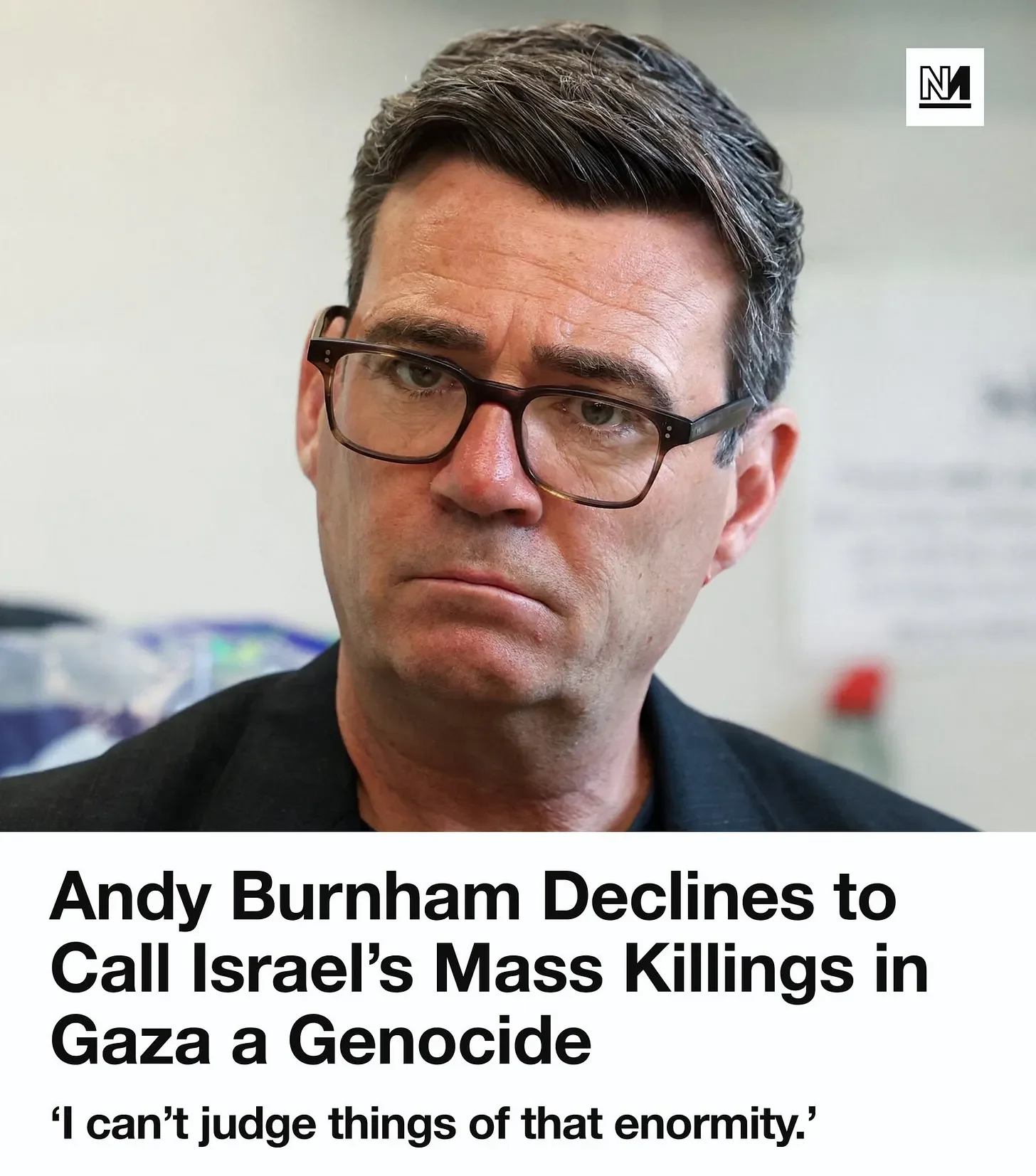
Courtesy of Novara Media, please follow Novara
Dip into Burnham’s background and be careful of the quagmire of shit you’ll soon have to wade through. Burnham has been a member of Labour Friends of Israel since 2015. The same year he said that if elected leader his first foreign trip would be to Israel—anticipating the treacherous line adopted by Andrew Cuomo, Eric Adams and other Zionist stooge candidates in last November’s mayoral elections in NYC.
Burnham also described the Boycott, Divestment and Sanctions movement as “spiteful”. Rather than identifying Israel as an apartheid state—which is just about the most generous thing that can be said about Israel these days—he called it a “democracy that has a long history of protecting minorities and promoting civil rights”.
During the 2015 Labour leadership campaign, which included Jeremy Corbyn running as the definitional reluctant-outsider candidate, Burnham repeatedly said that Corbyn’s plans for nationalising water and the energy companies lacked financial and economic credibility, even though the moves would have made the government money and improved the services. Corbyn with shadow chancellor John McDonnell fully costed the moves Labour’s 2017 manifesto.
While serving under Blair, Burnham voted in favour of the UK’s invasion of Iraq and has yet to apologise for supporting that war, which led to the death of one million civilians. In 2003 he voted against setting up a judicial inquiry. In 2006 he voted against a select committee inquiry. In 2007, 2008 and 2009 he voted against opposition day motions calling for an inquiry. His politics on western colonial wars and the tragedies that result are clear.
The other day, Burnham said that Blair “sometimes saw the market as always the answer”. Burnham studied English at Cambridge University but struggles to make sense. Maybe that’s why he also opposed Corbyn’s plans for free education in 2015 as well—if it hadn’t helped him, why should it help others?
After Jeremy Corbyn won a deserved landslide against Burnham and the even more right-wing Liz Kendall in 2015, Burnham became mayor of Manchester. He’d failed nationally and needed to rebuild and rebrand. He’s often seen to have done a good job in Manchester but it’s impossible to even begin to compare him to Zohran Mamdani.
As mayor of Manchester, Burnham has been welcomed mainly because he hasn’t been quite as bad as the Conservatives under their array of corrupt, ineffective, nationalistic leaders, or Keir Starmer, who has strained every sinew to be equally corrupt, ineffective and nationalistic—and has been very successful in these terms.
But Burnham’s achievements have been notably underwhelming. He stood up for Manchester during covid—that was his job. He also promised to build 6,400 homes by March 2025, but has delivered fewer than 2,000. He claims to have overseen the first renationalisation in 40 years with regard to his buses policy but has instead simply started to regulate privately-owned services. He’s allowed property developers to do as they like in Manchester—check my friend Isaac Rose’s excellent “The Rentier City: Manchester and the Making of the Neoliberal Metropolis” on this.
Zohran achieved exponentially more in 100 days than Burnham managed in nine years. In fact I apologise to Zohran for even placing him in the same sentence as Burnham. That’s a really mean thing to have done.
Of great concern, Burnham is also already pivoting to the right. On immigration he has diluted a number of his positions—including calling for an end to the immigration benefits restriction known as “no recourse to public funds” (NRPF), a major cause of homelessness for asylum seekers. Having objected to tougher settled status rules, he now supports them. He’s also adopted the language of detention and returns, directly echoing Reform as well as the Conservatives.
Yesterday Burnham’s position crystallised when he told BBC Radio Manchester that he wants to reform Home Office contracts with local authorities. “I do agree with what Farage is saying,” he said. “What we’ve got to do is get back to a sense of order.”
For those reading outside the UK bubble, Farage is the leader of Reform, the extreme right successor to Farage’s UKIP that could well win the next UK election. It’s certainly way ahead of Starmer’s vapid Labour party in the polls, which is one reason there’s been constant talk of a leadership challenge—with Burnham’s decision to contest the Makerfield by-election his first move to be able to launch a challenge. The only real opposition he faces in Makerfield is Reform. At the moment Burnham might be a couple of points ahead in the polls.
Would I prefer the result of the next general election to be a Burnham-led coalition government that includes the Greens, the SNP, Welsh Nationalists and Liberals, or a Farage-led government or coalition with the Conservatives? I’d prefer the Burnham-led coalition. But I wouldn’t vote for Burnham. Like millions of others, I’m not going to vote for someone who can’t work out if a genocide is happening or is wrong.
The next election also isn’t what’s in front of us right now. What’s in front of us is a longstanding Labour figurehead who is already playing games that replicate Starmer’s games. I decided not to vote for Starmer. I also decided not to cast a hypothetical vote for Kamala Harris. What has come out of that? Answer: a great deal of harm, but also the impending Trump implosion, the remarkable candidacy and election landslide of Zohran, and the promise that widespread change is finally underway within the Democratic party.
At least when Starmer ran for Labour leadership he made ten promises, each drawn directly from Jeremy Corbyn’s manifesto. He broke every single one of those promises. He might be the biggest liar in British political history. But at least he had the temerity to make promises and, having made them, we’ve been able to hold him accountable for breaking them—and vow never to vote for his ilk again.
The problem with Burnham is he’s barely making any promises. Even if it’s early for that, Burnham is already adopting Starmer’s evidently failed approach of seeking election victory by pivoting from some vague notion of the centre—which is really the corporate-establishment status quo, hoping that the left will tag along because it has nowhere else to go. Nobody has told him that that game of monopoly is over.
And just think: if Burnham is already shifting to the right less than a month after announcing he’d run in Makerfield, what’s going to happen between now and the general election? Imagine what kind of backsliding awaits! It will send shivers down your spine…
If the left hadn’t refused to vote for Harris, Zohran might not have broken through. If the left hadn’t renounced Starmer, maybe the Greens wouldn’t have enjoyed their current surge. The lessons are clear. We shouldn’t offer support to Burnham if he can’t even make a judgement on the genocide.
If Burnham loses in Makerfield on 18 June, that’s his responsibility, not ours. Whatever we do, we do with clarity. We build a coalition that will end Israel’s psychotic, genocidal, warmongering behaviour and that introduces meaningful democratic socialist reforms at home.