“The Zionist movement has become a death cult”
Tim Lawrence on Gaza, backlash, and the politics of the dancefloor
Annabel Ross “Politics of Dancing” interview, Substack, 17 March 2026
For nearly two and a half years, writer, dance music historian and party host Tim Lawrence has been an unusually clear and uncompromising voice in support of Palestine, speaking out publicly about Israel’s genocide in Gaza at a time when many in dance culture have stayed silent.
In this interview, he discusses his journey from Zionist upbringing to anti-Zionist activism, the backlash he has faced since October 7, the influence of Edward Said, and the connection he sees between protest movements and the dancefloor.
Tell me about your initial reaction to October 7, and what led you to publicly support Palestine on social media.
For the first couple of days I processed the breaking news of 7/10 in the outpouring of mass sympathy for Israel, the constant repetition that 7/10 was the most deadly day for Jews since 1945, and my lack of knowledge about Hamas. Although it took months for a full picture of what happened on 7/10 to come through, including Israel’s murder of potentially hundreds of Israeli-Jewish citizens via the Hannibal Directive, by the end of 8/10 it had become clear that Israel was hellbent on collective punishment, this after ethnically cleansing the Palestinians for more than a hundred years. So it took me less than forty-eight hours to realise that whatever the horror of 7/10, Israel was going to surpass that in no time at all and had to be opposed.
I attended the first national solidarity protest in London on October 5th. My partner, author Niki Orfanou, said we should go. Initially I hesitated, wondering if I might encounter antisemitism there, because this was how I’d basically been brainwashed growing up in a Jewish-Zionist youth movement. Then I realised that no instance of antisemitism, not even multiple instances, could even remotely compare to the Jewish-Zionist persecution of the Palestinians, so I understood that I had to attend and that any antisemitism would be outweighed by Zionist history. In the end, far from witnessing any antisemitism, I experienced this remarkable outpouring of humanity in which I was just one of many thousands of Jews who wanted to show empathy and solidarity. It became one of the most cathartic experiences of my life. Two weeks later, on October 19th, the day of the second national demonstration, I ventured into the quagmire of social media. My post received many more likes than I thought probable. Mixed among them were numerous anti-Palestinian comments, all of them passively or explicitly racist.
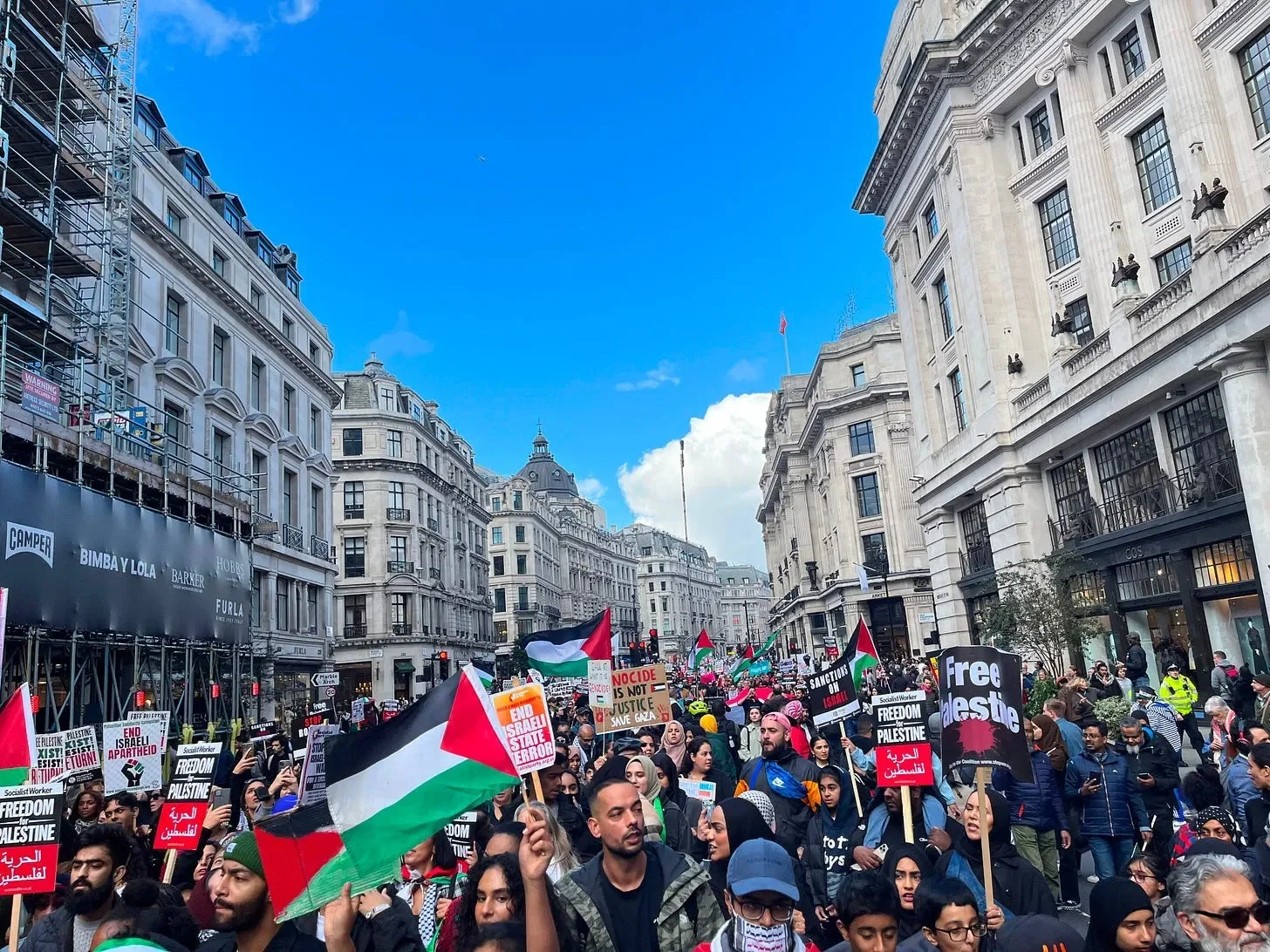
The first Palestine solidarity protest in London, October 2023. Image: Tim Lawrence
I first described Israel’s invasion of Gaza as a genocide in early November, which now seems quite early but at the time didn’t feel that way at all. I chose my words carefully. My dad had come out of Nazi Germany as a 15-year-old on the kindertransport, these escape trains that mainly the UK put on for young German Jews, so I knew my Holocaust history. The Jewish-Zionist youth movement experience had also trained me to be vigilant about any misuse of the word genocide or gaslighting of the German Holocaust. I knew what was going to come my way if I described Israel as genocidal, yet within a month the reality of genocide had already become undeniable. Once I reached that conclusion there was no turning back.
What was the reaction, initially, of the dance community to your social media posts?
There was a fair amount of pushback. One reader of Love Saves the Day, my first book, told me I didn’t have a clue about the Palestinians and Hamas, they’re all a bunch of terrorists, I should stick to writing what I knew about. A self-declared queer dancer asked me how I could sympathise with the Palestinians after they’d killed Israeli-Jewish ravers at the Nova Festival and argued I was discriminating against LGBTQ Palestinian ravers — as if they were free to come and go from Gaza as they pleased, and as if the life of a raver is worth more than the life of a non-raver. At the end of the first post-7/10 All Our Friends, a community dance party I co-host with Cyril Cornet and Cedric Lassonde that dates back to January 2018, a furious Zionist insisted that instead of playing the Mike Anthony version of Timmy Thomas’s “Why Can’t We Live Together” I should have stopped the music and screened a video of the 7/10 massacre. I began to realise that an awful lot of Zionists had completely lost the plot.
There was also way more support from within the dance community than there was hostility. At the next All Our Friends party a guy came up to me in the middle of the party and said, I hear you’ve taken a stand on Israel. I replied that I had but really didn’t want to have an argument in the middle of the dance floor. He said, No, no, I heard you’re an anti-Zionist and I just wanted to say hi! It was also heartening to connect with longstanding outspoken supporters of Palestinian justice, especially Manchester party host, DJ, label owner and producer Irfan Rainy. Many dancers got in touch to say that they didn’t feel they could speak out but wanted to show solidarity.
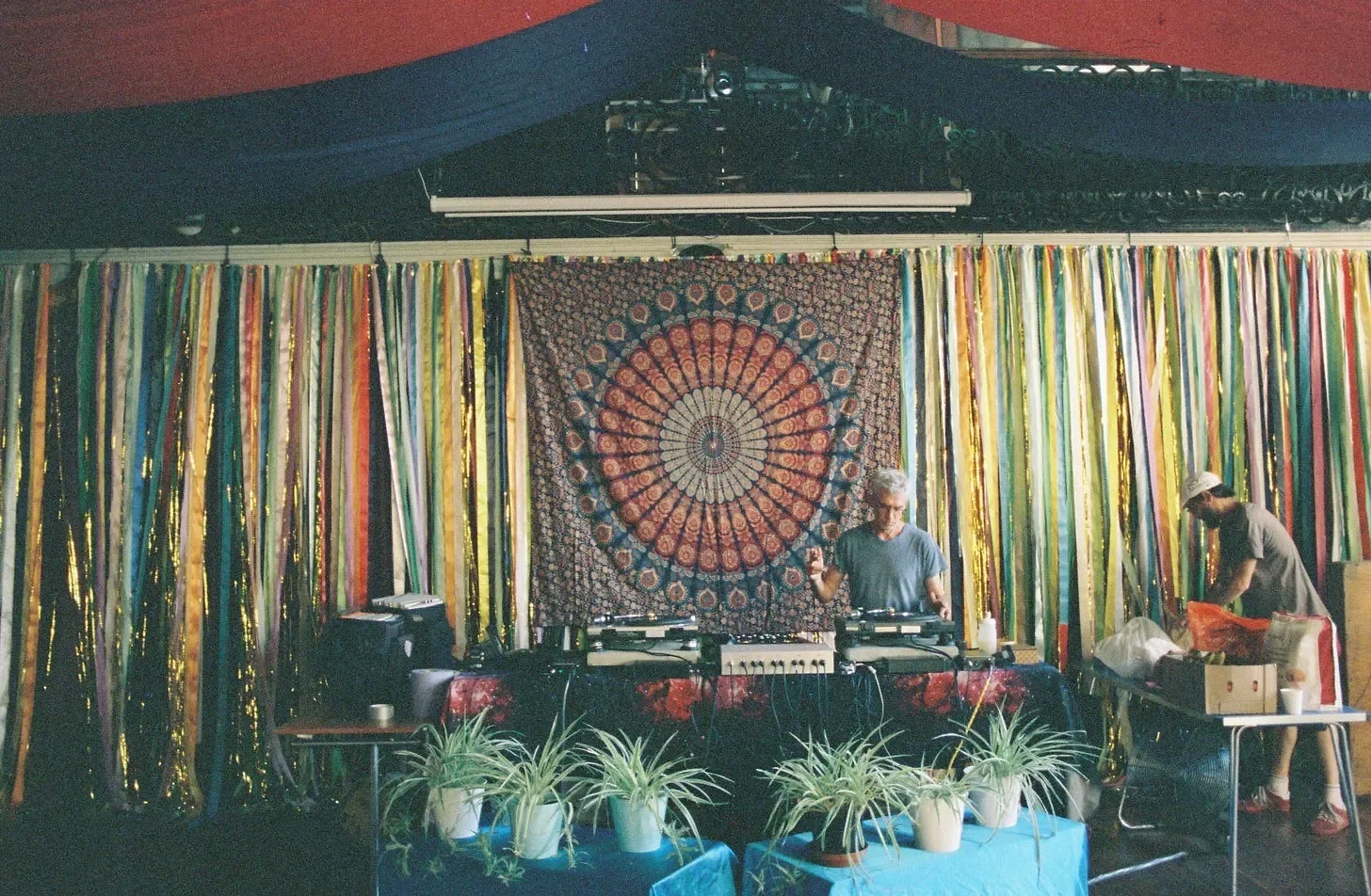
Tim playing at an All Our Friends party in May 2025. Image: Harry Knight.
I started to survey how the Israeli-Jewish producers and remixers — Red Axes, Disco Halal, etc — were responding to the genocide online. It turned out their idea of peace, love and harmony only extended to Zionists so I stopped playing their records. I got in touch with Acid Arab, two white guys from Paris who made their name by collaborating with Arab musicians, to ask if they were going to say anything. One of them replied that they didn’t want to get involved in politics. I thought, Wow, colonialism, and resolved to not play any of their records either.
How did it evolve as the months (and years) went on? Have you lost friendships or other important relationships? Has anyone who criticised you in the beginning subsequently changed their tune, or has anyone told you that your writing has helped them change their position on the issue?
The cohort of the Jewish Zionists I’d got to know through my teenage years and early twenties responded very aggressively. I hadn’t seen many of these people for forty years, yet they started to bombard my social media pages, call me a self-hating Jew and an antisemite, the usual knee-jerk abuse. Initially I was quite upset and thought that if I presented them with an alternative point of view they might come around. But after a few months max I realised that engaging with agitated Zionists was a complete waste of time, so I started to ignore them and block them. Some wouldn’t think twice about posting five or six consecutive comments that included links to woefully inept Israeli propaganda. When I told one of them he was behaving like a colonial Zionist, taking over and attempting to control a space that wasn’t his, he was completely bemused. Maybe a year-and-a-half into the genocide the accusations of antisemitism stopped. I started to wonder, am I going soft?
There was a second cohort of people I was closer to who weren’t maniacs and would have openly supported a two-state solution when we were eighteen-year-olds and beyond. A week after I started to use the word genocide a friend from my gap year in Israel who’d long since gone to live in Israel sent me a message that ended the friendship on the basis that “Israel has a right to exist”, “Israel has an obligation to ensure that its citizens can live here in safety” and “this is not a genocide”, plus Hamas has never had “any interest in protecting the people of Gaza.” By this point I’d become used to Zionists (Jewish and non-Jewish) streaming onto my posts to demand I condemn Hamas, associate Hamas with ISIS, apportion collective responsibility, all of the manipulative bullshit, so I was very familiar with the duplicity of my ex-friend’s arguments. I said, no, Israel doesn’t have a right to exist, an aggressor doesn’t get to claim it has to defend itself, people who are occupied have a legally-enshrined right to resist, and of course it’s a genocide. It turned out that everyone I knew who’d supported a two state solution sided with the point of view of this ex-friend. It became so hard to find a Zionist who had anything to say about the eradication of the Palestinians, I concluded that the Zionist movement had become a death cult.
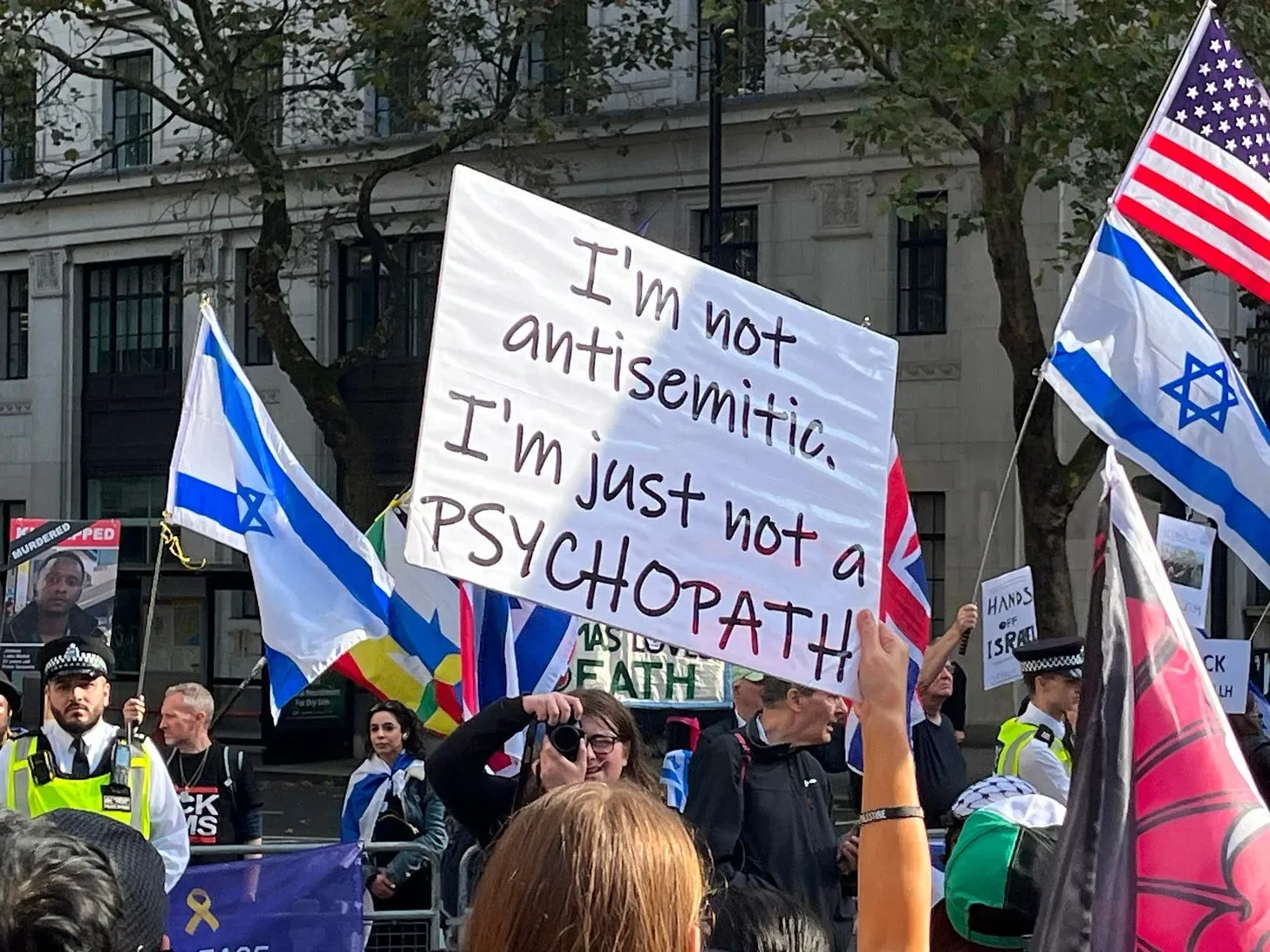
A London demonstration in October 2024. Image: Tim Lawrence
I did manage to hold on to three of my oldest friends from the youth movement era. I can’t say it was easy and I’m sure it wasn’t easy for them. There were periods when the friendships were close to collapse. But over a long period of time and many difficult conversions, plus one explosive public blow out, they all slowly came to accept that Israel has perpetrated a genocide and recognised the inherent tragedy of the situation. I’m not saying that I had anything to do with their shift, just that there was a shift.
A final historic friend from the youth movement, Richard Hermer, a high-flying human rights lawyer and longstanding close friend of Keir Starmer, became Attorney General following Labour’s election victory in July 2024. Soon afterwards it became clear that the Labour government wasn’t merely continuing the previous Conservative government’s approach to Palestine, it was deepening and extending the UK’s support for Israel. I’d gone out for lunch with Hermer shortly before the election and when I asked him if he’d accept the position of Attorney General if Starmer offered it to him, he said yes. When I told him I believed he shouldn’t accept any offer on ethical grounds, he replied that he would use the position to fight for progressive change from the inside. Once in post, Hermer gave Starmer all the key legal advice he needed to continue and expand the UK’s support for the genocide, which included an increase in the supply of military weapons, spying missions, diplomatic support and meetings with top Israeli politicians and military generals as well as the systematic clampdown of the solidarity movement. When Hermer and I went out for our first lunch of the post-election period in January 2025 I concluded by telling him I thought he should be tried for war crimes and should resign his position immediately. I urged him to continue the conversation but never heard from him again, despite numerous attempts. I tried to influence him as best I could, which I took to be my duty. I failed.
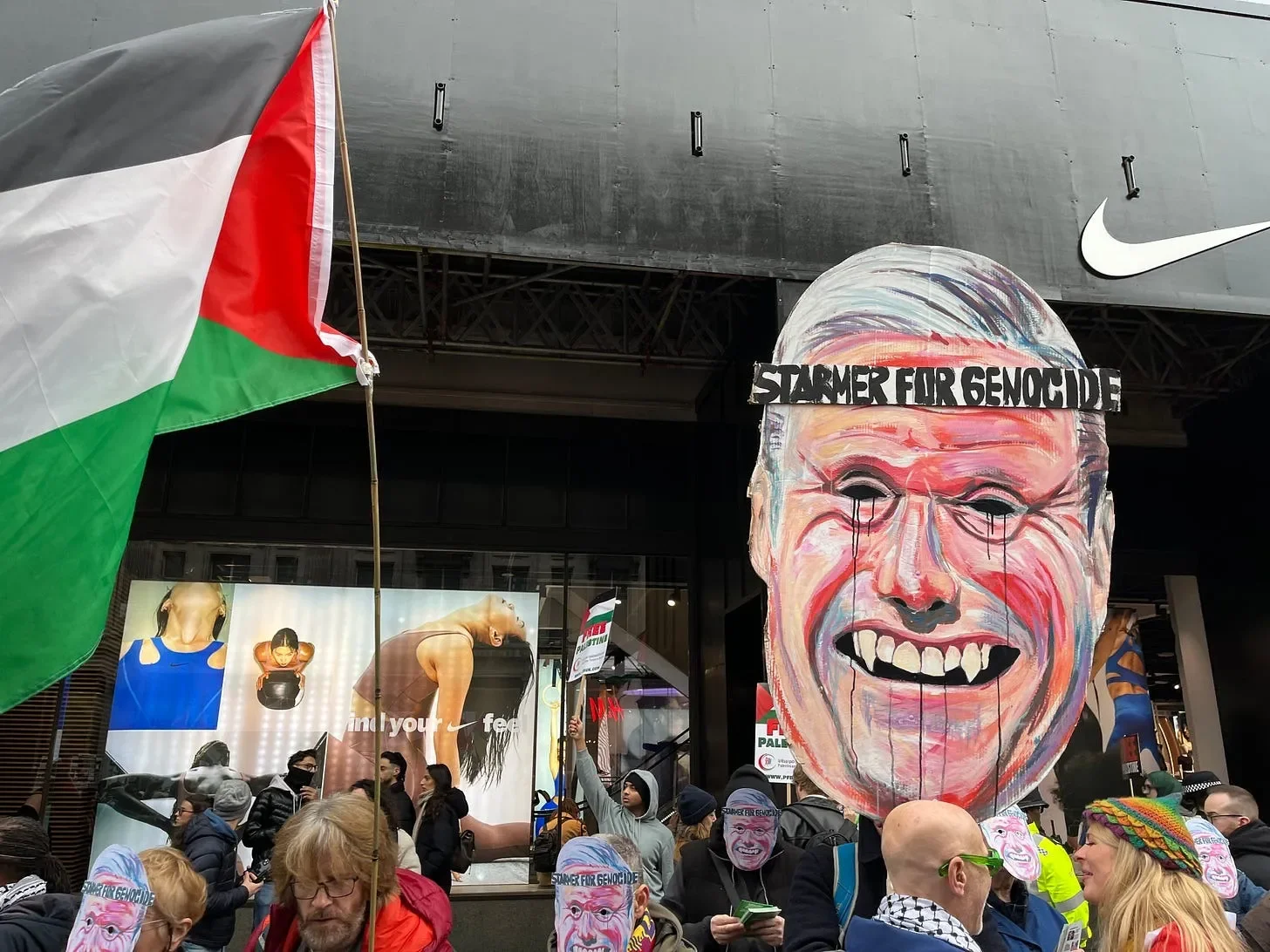
Another Palestine protest in London, January 2024. Image: Tim Lawrence
Did your Palestine advocacy increase the time you spent online, and especially on social media? Many times at the height of the genocide I really resonated with what estoc said: “How can you possibly think about anything else?” I know not everyone was following it as closely as we were but it was unavoidable…to see people going on as normal felt completely mad. To focus wholly on it is insanity-inducing, to not focus on it all feels callous and selfish, to half-focus on it is also a total mindfuck when contrasting your daily existence and off-topic social media posting with the horrors going on there. How have you felt about it all? What’s your relationship with social media like now?
I relate to estoc’s comment. You look at what’s been going on and it can easily be overwhelming. I know a bunch of people who’ve needed to take breaks. When I started to think it was becoming a bit much I started to regulate how much I read and in particular when I read. I tried to focus on what I can do practically, which is to go to demos, boycott companies and write.
Prior to 7/10 I’d largely withdrawn from from social media but it quickly became this space where scores of academics, activists, independent journalists and advocates countered the western, colonial, Zionist narrative and developed this massive following—inspirational figures such as Bisan Owda/@wizard_bisan1, Francesca Albanese, Greta Thunberg, Norman Finkelstein, Max Blumenthal—so I started to post as regularly as I could manage. Most of my posts ranged from 100-1,000 words. Then in December 2024 Raoul Galloway, an old friend from the dance scene who edits a literary journal called Spinners, invited me to write a longer article about Palestine. After that I began to direct my pieces towards Substack because the economic model was better than FB and instagram plus its sober format was more welcoming for more ambitious articles. It was easy to post these pieces on FB, even if they could seem a bit out of place there. I didn’t really care and to my surprise I ended up getting the best engagement on FB while instagram dropped away.
A turning point came in the summer of 2025 when I wrote this long, ecstatic report from the Greek island of Syros, where Niki and I participated in the day-long protest that prevented an Israeli cruise ship from docking—best holiday experience ever. A few days later I wrote an even longer article that exposed ten Zionist myths that started to circulate right after the protest. Then I posted on the relationship between Zionism and Nazism. Without even having to think much about it I provided ten examples of how the two were similar and another ten that pointed to ways in which Israel’s genocide was worse than the Nazi genocide. I thought I was venturing into taboo territory but there was very large support on FB in particular. I was like, Wow, opinion is becoming really clear.
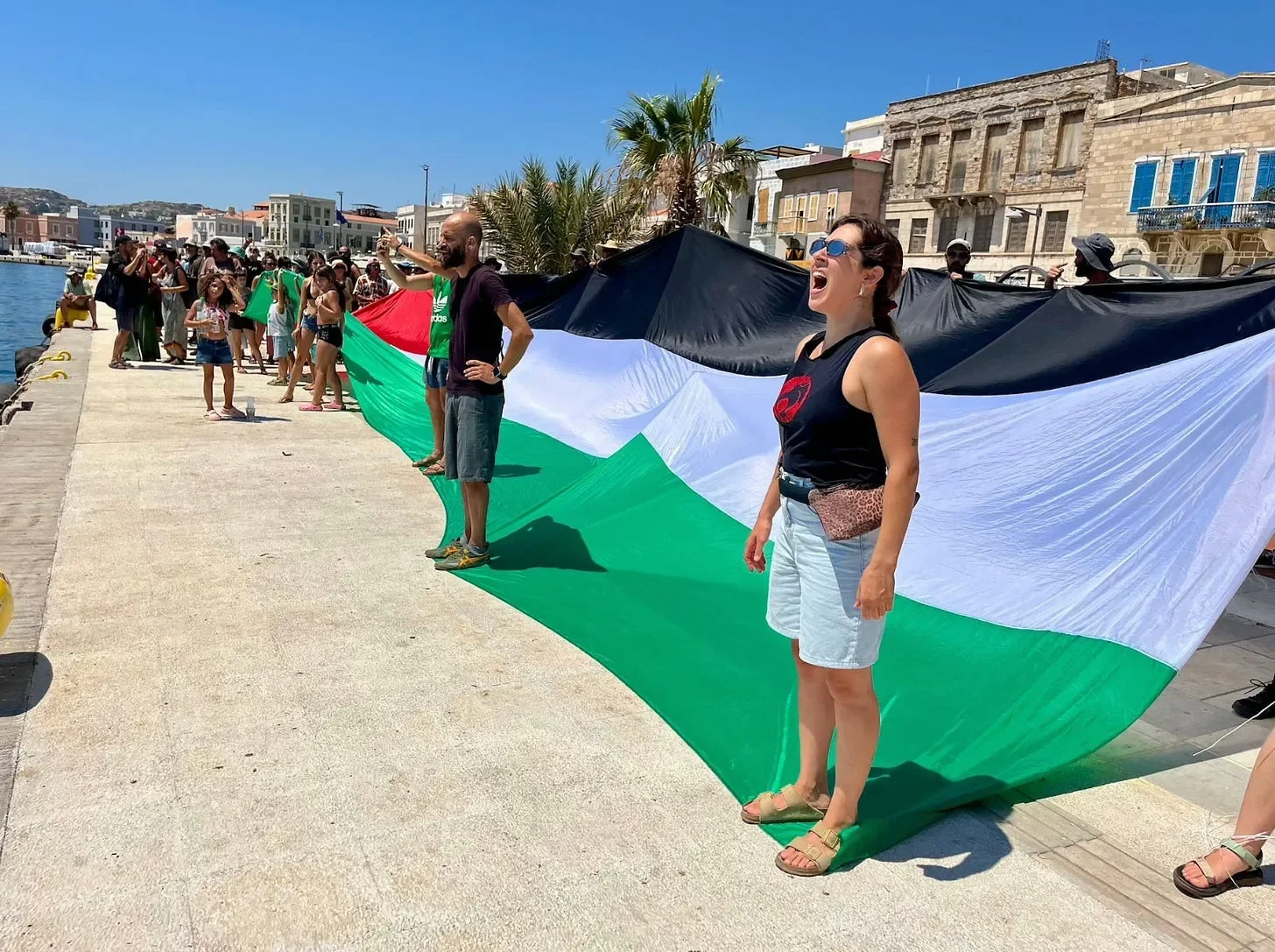
At the protest on the Greek island of Syros. Image: Tim Lawrence.
During a period of disillusionment early in your career you left a job at the BBC to take a class with Edward Said. What was it like being taught by him? What did you learn from that class? Does any of what you learned from him inform what you are doing now? It feels quite meaningful that you were poised to write a biography of Said, then started writing about DJ culture in New York instead, and now have found yourself writing about Palestine.
After university I started out in political journalism and after three years ended up at Newsnight, the BBC’s late-night current affairs show. It was supposed to be a dream job but on my way to work that first morning I began to see a psychotherapist and more or less immediately understood that I wanted to move into something more contemplative. My dad and mum had passed in 1987 and 1990, and I was struggling to come to terms with the loss. Going out every Friday night to Feel Real at the Gardening Club to hear the latest house sounds kept me going, but I wasn’t finding much meaning in British politics, which had entered an interminable rut. A few months later Edward Said delivered the BBC Reith Lectures on the theme of the intellectual and devoted one session to the public intellectual, which led me to appreciate that it was possible to work in a university setting and be outward rather than inward-facing. Soon after I read Edward’s recently published Culture and Imperialism, which became a best seller. I realised that I also wanted to write long, immersive books that explored the politics of culture. I started to plan to move to New York so that I could go to dance at the Sound Factory Bar every Wednesday night and also hopefully study with Edward at Columbia University.
By the time I got to take a seminar with Edward he’d started to teach this slightly obscure topic: Last Works, Late Style, later published as On Late Style. I was mildly disappointed to have missed his classes on colonialism yet also honoured to sit in the same room as him—he was very charismatic, very intense, very handsome, a major, major figure. The seminar drew on classic works from the western canon, including Beckett, Euripides, Genet, Sophocles and Oedipus, but Edward’s readings were highly political and the underlying argument radical: as authors and composers grow older they don’t become mellower and sweeter, as popular wisdom has it, but bolder and more daring, as if their looming impermanency freed them from fulfilling the expectations of their audiences. Meanwhile Edward’s latest book, Peace and Its Discontents, came out a few weeks into the seminar. Israel and the PLO signed Oslo II a few weeks later. Israeli Prime Minister Rabin was assassinated as the class rolled on. During this period Edward fell out with Arafat over the Oslo Accords, which he judged to be a betrayal; history has shown that Edward was correct. I developed what felt like a warm and interesting conversation with Edward that led me to write a journal article about the class, Edward’s chronic illness and exile.
While I was writing the journal article about Edward, a somewhat distant friend from the year off in Israel who was making his mark as a literary agent suggested that I should write a biography of Edward. I was interested in the idea but aware that I would need to deepen my communication with Edward first. Ignoring my instructions the agent proceeded to cross boundaries and that was that. More or less simultaneously I started to interview David Mancuso for what was supposed to be a history of house music culture – the book that became Love Saves the Day. I was better placed to write that book and became completely absorbed by it. I continued to write almost exclusively about New York DJ/music/art culture 1970-83 until 7/10 and my turn to writing about the genocide. Edward became a much-circulated figure on social media during the first year of the genocide. There was a certain completing of the circle.
When I returned to London in the summer of 1998 I didn’t believe there was any point trying to influence Israel from within the conservative British Jewish community but also had no entry point into Palestinian politics. When 9/11 arrived I empathised with the innocent civilians who lost their lives and also thought, now you know what it’s like to have people blow up your buildings. The February 2003 protest against the Iraq war, which attracted more than a million people in London, was incredible but Blair believed he had god or power or both on his side and didn’t pay any attention. Soon after I turned my attention to co-hosting Lucky Cloud parties with David Mancuso, the host of the Loft and the pivotal figure of Love Saves the Day, Jem Gilbert, Colleen Murphy and a wider collective of friends. The first eight years were really compelling — magical, really — but when David stopped travelling to London in 2011 following doctor’s orders the party lost some momentum and went through some internal changes, and I experienced this sense of isolation and drift.
Slowly, improbably, this pathway opened up. In 2015 I joined the BDS academic boycott of Israel in 2015. That same year I also became an active supporter of Jeremy Corbyn during his campaign to become leader of the Labour party. The Jewish Zionist lobby immediately tried to stop Jeremy by branding him an antisemite and persuaded the UK establishment, including most Labour MPs, to join their smear campaign. This continued until Jeremy resigned in the aftermath of his election defeat to Boris Johnson in December 2019. That whole episode was revelatory and anticipated what would only intensify after 7/10.
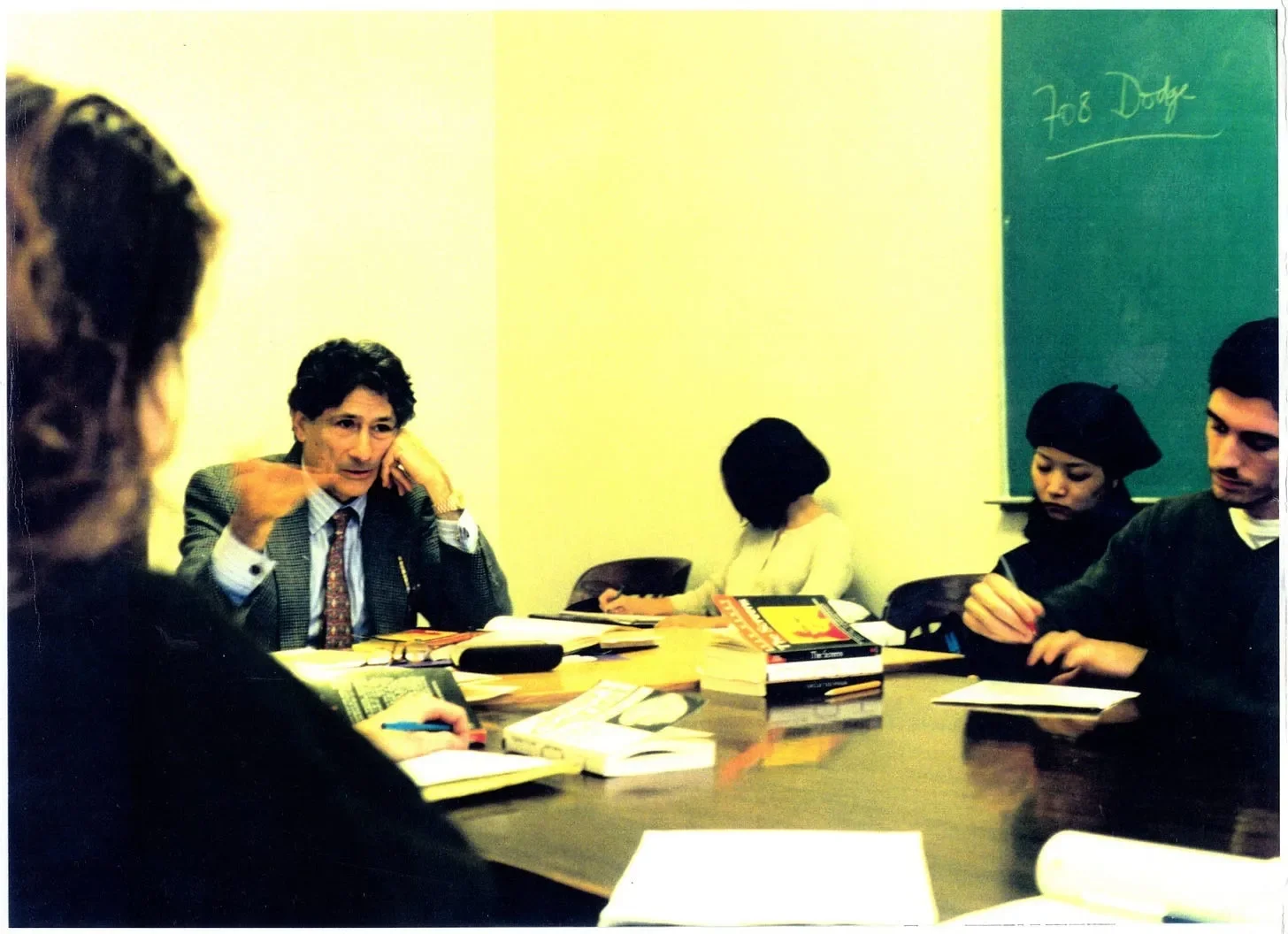
Tim Lawrence, front right, attending a class at Columbia University taught by Edward Said, rear left, in December 1995. Image: Rainer Ganahl,
About attending the protests in support of Palestine, you have written, “Although the circumstances are different, the feeling I get from the demos connects with the feeling of collective joy that’s always also generated at a good party. David was right to point to a line that exists between the street and the dance floor. It’s called collective joy and is rooted in solidarity.” Can you talk more about this, and where and how you’ve experienced it? It feels as though it’s harder to find this feeling on dance floors these days, but perhaps I’ve been going to the wrong parties.
During research for Love Saves the Day David once told me, ‘‘I was on the streets and in the party. Dancing and politics were on the same wavelength, and the Loft created a little social progress in tune with the times.” He was referring to his life in New York City during the second half of the sixties and the opening years of the seventies, when he developed a deep affinity with the civil rights movement, became an active participant in the anti-war movement and at the same time discovered his love of partying, especially in Harlem’s rent parties and membership spaces. In 1966 he started to host parties in his loft at 647 Broadway and on February 14th 1970 introduced the approach that came to be known as the Loft. In some fundamental way these developments—the street protests and the community-oriented parties—were part of the same energy for David.
I was deeply drawn to the idea that the street protest and the party were part of the same continuum but didn’t feel it was something I’d experienced because the years when I felt most connected politically hadn’t overlapped with the periods I felt most connected to the dance scene. There was this weird inverse relationship, but that changed abruptly after 7/10. All Our Friends always felt like an intentionally open, egalitarian, transnational grouping to me, but I and many others felt politically isolated as Jeremy’s leadership collapsed, the Tories returned to power and Starmer hollowed out the Labour party. So it wasn’t until I went to the first solidarity demonstration that I finally experienced a connection between the party and the street.
The main feeling that’s available when we go on a protest or become part of a connected dance floor is that we’re not alone. We live in an increasingly individualised and isolated world, in many ways the internet and social media reinforce that experience. It’s easy to feel helpless in this situation, especially given that western corporate media echoes the ideology of the power elite. Keeping track of the genocide has in many respects been the most disheartening experience of my life. But we can also feel a sense of commonality and solidarity when we enter into these collective situations, which can be very empowering, and that’s been my experience.
The street protest and the demonstration are different in all sorts of ways, but they’re similar in terms of their openness and ability to generate group self-belief. I guess the operative word is “ability”. After 7/10 I quickly reached the point where simply “being together with others” wasn’t enough by itself. I mean, I couldn’t and can’t feel a sense of proper collective joy if I have a strong sense that there might be a bunch of genocide apologists in the room. There are many spaces where I feel it’s commonly accepted that we must oppose the genocide, but there are just as many spaces where I don’t get the same feeling, and as far as I can tell the hedonistic, consumerist end of dance culture isn’t particularly locked in.
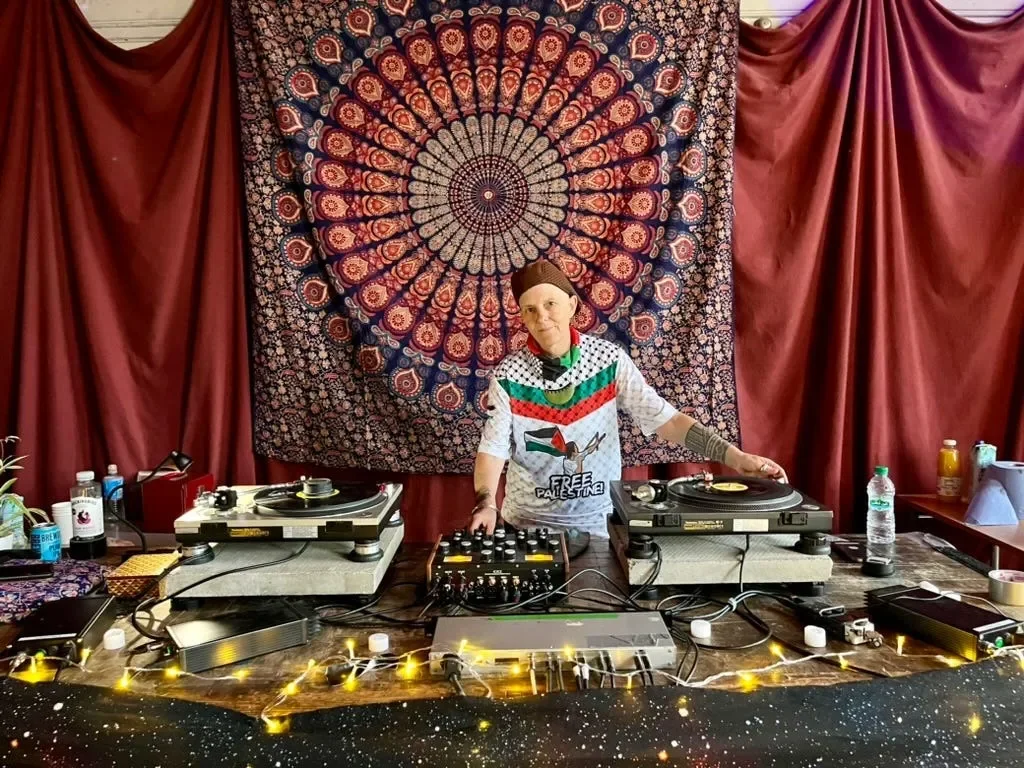
Guest DJ Nikki Lucas at an All Our Friends party in May 2025. Image: Tim Lawrence
If there were any genocide deniers in the All Our Friends crowd I think they’ve moved away during the last two-and-a-half years. Ced, Cyril and I started to select anti-war songs at the first post-7/10 party. We’ve donated to Palestinian causes such as UNRWA and UNESCO plus peace activist movements such as Stop the War Coalition. On days when there’s been a clash with a protest a significant number of people would come from the demo to the party; there’d be spontaneous chants of “Free Palestine!” during the final back-to-back. At one gathering our guest DJ and political activist Nikki Lucas waved a Palestinian flag from behind the turntables to rapturous applause. I began to wear a watermelon t-shirt to the parties. Overall our parties feature a lot of music that isn’t conventionally US or UK-centric, so that sets a certain tone.
There are also signs that the feeling is growing at Lucky Cloud. I was musical host for the second four-hour set at our October 2025 party and ended up introducing two sequences that, at least for me, spoke to the moment. During preparation I thought back to the anti-war, internationalist articulations of the historic Loft and how I might attempt to channel that spirit while a genocide was unfolding and within a moment when Arab, African and Asian-influenced music was much more accessible (in the West) than before. At Lucky Cloud’s party in February 2026 one woman was wearing a Palestine Action t-shirt. We hugged.
These days co-hosting All Our Friends six times a year and Lucky Cloud three times a year takes up a lot of my going-out energy, so it’s hard to comment on the wider scene, but like you my sense is that the feeling of collective joy is diminishing for many different reasons. When I do go out it’s almost invariably to a solidarity, antiwar or anti-fascist demonstration and there the feeling of commonality and solidarity is extremely strong. Although the marches don’t generate euphoria in the same way as a tuned-in dance floor there’s a lot of chanting, drumming, clapping, dancing, plus everyone gathers around the stage at the end to hear the speakers, where there’s unity, more chanting and applause. Inevitably the mood is bitter-sweet but I always feel inspired by the gatherings and come away with renewed energy, greater hope and a fortified sense of purpose.
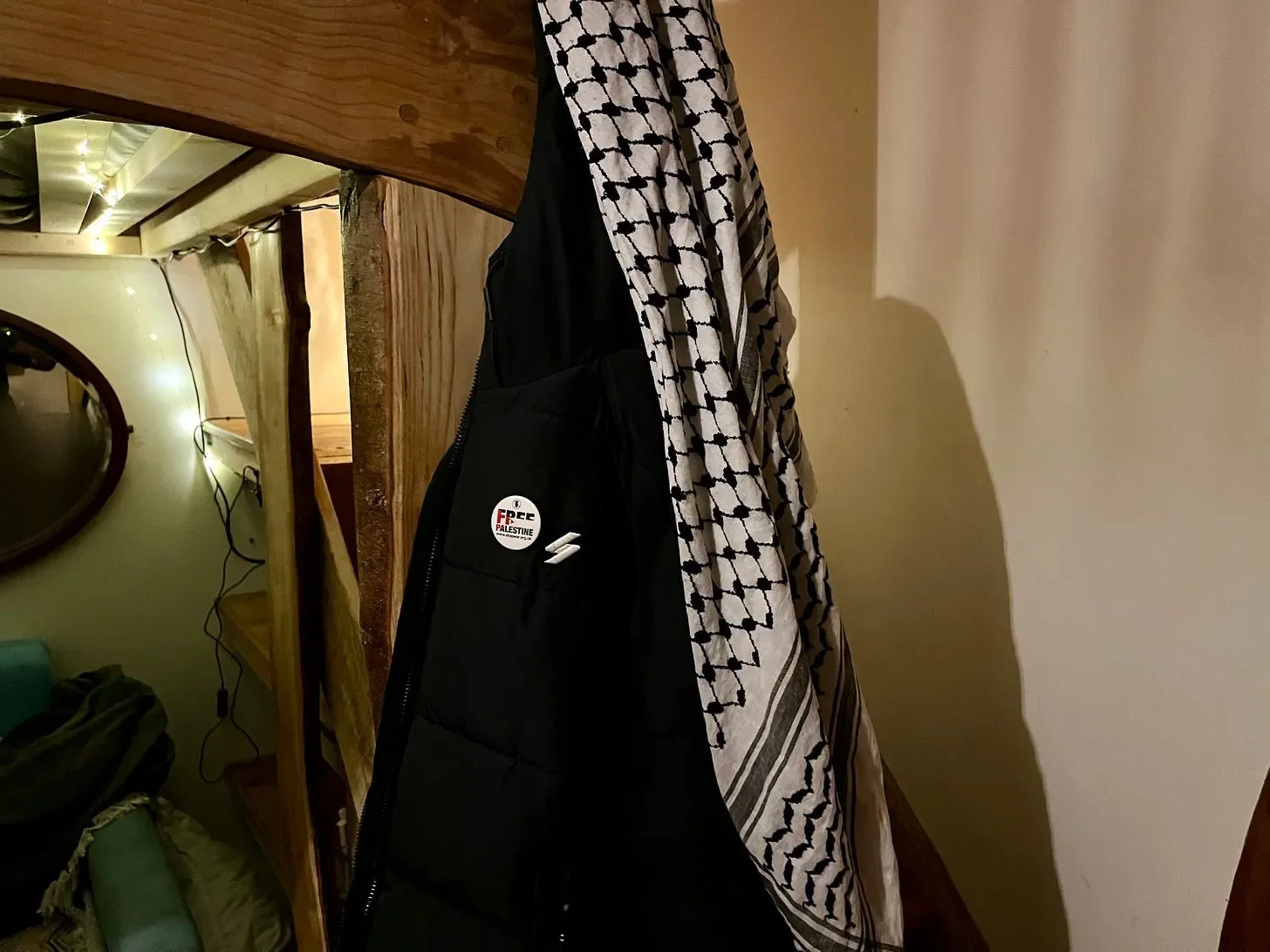
Image: Tim Lawrence.
How has the genocide in Gaza changed you as a human?
Everything has been amplified, every aspect of consciousness heightened. It’s transformed how many of us see and live in the world. From that first rally onwards I understood that I had made a lifelong commitment to Palestinian justice as part of a wider movement for global justice. In different ways, the dance floor can make a contribution to that. There are so many other ways we can contribute as well.