Israeli election racism, Zionism is racism, and the crushing of Palestinian Israeli hope
30 October 2026
It’s very strange and also not strange at all. As Israeli society becomes more and more racist, and as the UK and wider Western public realise that this racism is fundamentally linked to the ideology and practice of Zionism, the more the Zionist movement accuses people who reach this conclusion of being the real racists. It’s similar to the stupid child who is told they’re stupid replying, “No, you’re stupid,” but a lot worse.
There are all sorts of reasons why the structurally racist character of Zionism has come to the fore this autumn. The shift from peak-heat genocide to the slow burn of ceasefire genocide has allowed for more contemplation when the leaves start to fall. The mid-term suspension of the US war on Iran has opened up further space for theoretical thinking. The new Labour government’s West Bank sanctions policy, which amounts to inaction disguised as action, encouraged solidarity campaigners to address fundamentals in addition to policy. The Green Party’s Zionism Is Racism policy, the publication of Benjamin Moser’s Anti-Zionism, and the histrionic response of the Zionist establishment fuelled the argument.
Certainly there were times during the furore that it was hard for those who believe that Zionism is Racism to be heard above the megaphone outrage of the backlash. I don’t think I’ve ever seen a politician be so consistently interrupted and disparaged during interviews as the miraculously polite Zack Polanski. When the Labour government announced its scandalous policy to combat antisemitism in British schools without providing details of the tiny number of incidents that prompted the policy—maybe a student had a watermelon pencil case, or said that they thought Israel’s genocide was wrong—it really did begin to feel as though Zionists (not Jews) might win the argument by other means.
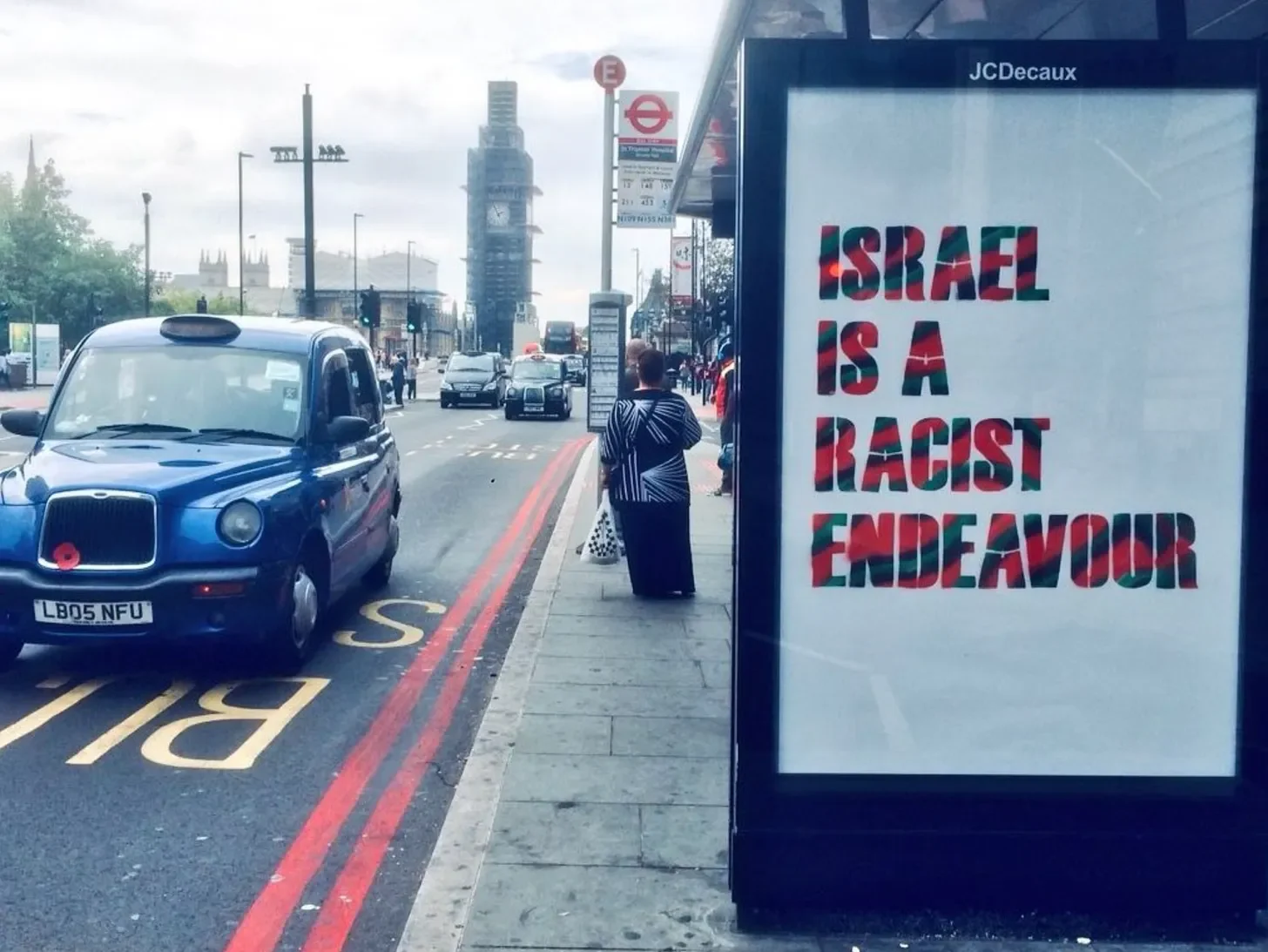
Yet during this whole period, which only lasted a month, I had a strong sense that, even if it was complicated, the move to highlight the intrinsically racist character of Zionism was a good move that over time could only end one way. Social media posts that attacked the thesis seemed to overwhelmed by people posting comments that explained, no, if you study the history Zionism really is inextricably linked to racism. Meanwhile the gathering momentum of the Israeli election, which repeatedly featured racist politicians attempting to disappear the Palestinians, illustrated the thesis in real time.
During the Israeli election Netanyahu, “change” alliance leader Eisenkot and their main political accomplices portrayed Israel’s Palestinian voters as enemies from within. They made it clear that they wouldn’t enter into an agreement with Palestinian representatives under any circumstances, no matter what they might argue, and irrespective of the fact that, even after ethnic cleansing, the Palestinians still made up 20% of Israel’s population. For almost 80 years Israeli Jews had governed the indigenous Palestinians via a mix of apartheid, ethnic cleansing, occupation and genocide. Now, in the first general election to take place post 7/10, they were going full fascist.
Netanyahu tried to ban the Palestinian parties from participating in the election, which carried echoes of 1930s Germany even if the Supreme Court overruled his move. Israel’s prime minister went on to argue that forming a coalition that included Palestinians was “simply forbidden”, would “endanger Israel” and would amount to “treason”. He stirred up racist fear—in a country where, according to a University of Pennsylvania poll conducted in March 2025, 56% of Israeli Jewish citizens support the expulsion of all Palestinians—by claiming that the Eisenkot bloc was planning to form a coalition with the Palestinian parties. He said that any party that entered such a coalition would be a “shame and a disgrace”.
Ben-Gvir released a widely-circulated AI video that depicted Palestinians being led into what resembled a concentration camp, entering into the building on a conveyor belt looking healthy and emerging gaunt. Smotrich published an AI ad that proposed to extend West Bank settlement policies to the Negev and Galilee. Ben-Gvir argued that the Palestinians are “not even people” and called for the government to kill “30 to 40” people in Gaza every night. Smotrich added that “Jewish settlements will be established in Gaza”. When he discussed the possibility of forming a government with the Ra’am, the Palestinian party led by Mansour Abbas, Smotrich referred to Ra’am as “supporters of anti-Zionist terrorism” and claimed that forming a government with them would be “more dangerous than October 7”.
During the campaign, Israel’s elections committee voted to disqualify Sami Abu Shehadeh, who leads Balad, one of the Joint List’s three parties, at the request of far-right Security Minister Itamar Ben-Gvir. The petition cited an article in which Shehadeh had described the Hamas attack of 7/10 as an “important historical event.” After the Supreme Court indicated it would uphold his disqualification, Shehadeh withdrew from the race. He later said the episode showed that Israel has “two different judicial systems, one for the Jews and one for the Arabs.”
Eisenkot insisted that under no circumstances would he enter into any kind of alliance with the Palestinian parties. For instance, in mid-October he stated: “Whoever does not accept that Hamas is a terrorist organization, that it needs to be dismantled and destroyed, will not be a partner in the next government.” In this way he ruled out the prospect of forming an alliance with any Palestinian party because Palestinian representatives understood that this framing of Hamas was a pretext for continuing the genocide. Eisenkot only criticised Netanyahu, Ben-Gvir and Smotrich for damaging Israel’s international reputation, not for the content of their anti-Palestinian statements.
Two of Eisenkot’s prospective coalition partners—Avigdor Lieberman of Yisrael Beiteinu and Naftali Bennett of B’Yachad—also ruled out any coalition with Palestinian parties. Lieberman is a far-right fascist who pronounced that “there are no innocent people in Gaza” and has long refused to countenance entering a government with the Palestinians or, if he was given a significant portfolio, with Yair Golan, leader of the Democratic Party.
Eisenkot, the figure who was meant to encapsulate change, had been associated with the “Dahiya Doctrine” as Northern Command commander and served as IDF chief during the 2014 war on Gaza. The doctrine advocated the use of “disproportionate force” against civilian areas used by armed groups and is widely believed to have resulted in at least 2,251 Palestinian deaths, of which at least 1,462 were civilians, a third of them children. Eisenkot talso served in Netanyahu’s war cabinet between October 2023 and June 2024, so took part in the first eight months of the genocide.
During the campaign Naftali Bennett of B’Yachad, part of the “change” coalition, stated that he would oppose the establishment of a Palestinian state and promised that he would “continue to settle in Judea and Samaria”. He sought to extend Israeli sovereignty over Area C of the West Bank, which comprises about 60% of the area, leaving the Palestinians with limited civil control in Areas A and B. Only Yair Golan of the Democrats, said he would support the establishment of a demilitarised Palestinian state and would be prepared to work alongside a Palestinian party in government.
In short, despite internal differences, the Israeli political establishment conspired to exclude the Palestinians, a racial minority group that constitutes 20% of the Israeli electorate, from being part of the mainstream election process, with the sole exception of Golan. They did this even though Israel is a country where there have only ever been coalition governments. They also did this without engaging with anything the political representatives of the Palestinian parties were saying.
Can you imagine if politicians in any other liberal democracy ruled out working with other politicians based on their ethnicity or race? Institutional racism runs deep throughout the Western world, especially in countries rooted in colonialism. But the politicians who govern in these systems are at least committed to pretending that everyone should be treated equally, irrespective of their background. Leaders even go to great lengths to include people from ethnic and racial minorities in their cabinets, just so long as they don’t do anything to threaten establishment control.
In Israel, however, they don’t even pretend. It’s completely standard to treat the Palestinians as a foreign entity that threatens to undermine the virtue and strength of the nation’s polity.
This is of course a trait of fascism. Yet the Western establishment has gone out of its way to celebrate the democratic underpinnings of the Israeli political system, to create the illusion that genuine political choice is on offer in Israel when it isn’t, and to attack not Zionism but critics of Zionism as the racists in the room.
And the racists in the room are—you guessed it!—the people who oppose racism
One of the most sickening aspects of the Israeli election campaign was the way the Western mainstream media—the BBC, the Guardian, the New York Times—repeatedly presented the Eisenkot “opposition” as being centrist, liberal, even left-wing. It was as if they realised that the racist Netanyahu myths they had swallowed and regurgitated after 7/10 in particular weren’t going down so well with their audiences, never mind their pissed-off journalists, and they needed to do something about it.
They did this even though nobody within the Eisenkot camp acknowledged Israel’s apartheid legal structure and rule, ethnic cleansing and genocide, or said they would in any way withdraw from the occupied territories. The idea of creating a Palestinian state was completely ruled out. The offering wasn’t even racism lite. It was racism full-on with a commitment to hold an inquiry into 7/10, introduce mandatory conscription (more IDF!), and roll out a new set of smiles on the diplomatic stage—smiles not tarred with the stain of 21,000 dead children.
The Western power elite couldn’t wait for the opposition to defeat Netanyahu. That way they could distance themselves from Israel’s genocide and, if it came to it, blame it all on Netanyahu, Smotrich and Ben-Gvir—just as everyone who partook in Biden’s active support for the genocide has been doing these last 12 months or so. You can just smell Rishi Sunak, David Cameron, Keir Starmer, David Lammy, Yvette Cooper and Richard Hermer rubbing their hands with glee—even if they’ll never be able to wipe them clean. “Out, damned spot! out, I say!”
The Western political and media class had nothing to say about Eisenkot’s refusal to even have a conversation with the Palestinian parties never mind address the definitive problem of their longstanding, intensifying racist repression. The Guardian published only one dedicated pre-election feature about the Palestinian lists. Has there ever been a self-styled liberal newspaper that’s so consistently adept at ignoring any grassroots movement that promises change? Only when they break through does the Guardian wake up—usually to do whatever it can to send it back to sleep. Just a little propofol to send you back to sleep.
Instead the racism the Western establishment is obsessed with is—again and again and aagain—antisemitism, which apparently is out of control. This happens even though the antisemitism almost invariably amounts to criticism of Israel and the Zionist conflation of Judaism and Zionism. Out-of-control yet almost impossible to detect, antisemitism has led Faber to stop supplying Sally Rooney’s books in the UK because it cannot pass on her UK earnings without risking prosecution, given her pledge to donate royalties to Palestine Action. The schools report into antisemitism reported that 29 out of 92 Jewish respondents experienced antisemitism in a total survey of 5,000. The government didn’t think it was necessary to do anything about Islamophobia (a word it refuses to use) or anti-Black racism.
Rather than identify Israel’s out-of-control racism, UK political parties prefer to label the people who are challenging Israel’s racism as being racist themselves. This strategy crescendoed when the Labour government, the Conservatives, the Liberal Democrats and of course Reform attacked the Green Party’s Zionism is Racism motion, passed at its recent conference, as being antisemitic. The leaders of these parties have instructed local councillors to terminate all cooperation with the Greens, preferring to let local services collapse rather than endorse the Greens’ position on Zionism. The mainstream media followed suit, with Jonathan Freedland of the Guardian and Laura Kuenssberg of the BBC trying to politically assassinate Zack Polanski—a Jew.
Along the way the power brokers of the establishment haven’t come up with a single argument to meaningfully challenge the Green Party’s claim about Zionism and racism. They haven’t explained how the Jews—however much they wanted their own state, however much they felt they deserved their own state, and both arguments are flimsy—could go about this in Palestine without ethnically cleansing the indigenous Palestinian people. Nor did they manage to refute the argument that Israel has only established and preserved a Jewish majority through apartheid, ethnic cleansing, occupation and genocide.
But of course the racists in the room are the people who criticise Israel or dare to suggest that a single democratic state in which citizens (including Jewish citizens) have equal rights deserves to be considered alongside the oft-cited but never acted upon two state solution.
Stupidity, hubris
It’s easy to find all of this depressing but we need to remember that, for those of us who live in the US, the UK and Germany, things look very different outside of the bubble. Also all empires come to an end at some point. Then there’s the universal law that arranges for the richest and the most powerful to be sufficiently hubristic to always bring about their own downfall.
When the UN passed a resolution to create the State of Israel back in 1947 it maintained that a Palestinian state should be created alongside Israel. Come the Declaration of Independence of 14 May 1948 Israel ignored that obligation and embarked on the Nakba instead as what it deemed to be the quickest way to establish Jewish majority control—because at the moment when Israel declared its independence there were 625,000 Jews and 940,000 Palestinians living within its borders. The Nakba, which led to the killing of 15,000 Palestinians and the expulsion of another 750,000, sorted that out—but not, it turned out, for good.
There have been times during the last three years when people who support justice for the Palestinians have looked almost everywhere for hope other than within Israel’s 1948 borders—Gaza, of course, also East Jerusalem and the West Bank, plus South Africa and the countries that supported its case against Israel, the ICJ, the ICC, the global solidarity movement including the flotilla activists and the BDS campaign, the anti-colonial resistance in Iran, Lebanon and Yemen, and the musicians, actors, directors and writers who’ve stood up.
Out of the terrible ramifications of the genocide, the Palestinians, who make up 20% of Israel’s 1948 population, found a voice like never before. It’s strong, it’s vibrant and it’s clear. The direct victims of Israel’s brutal domestic clampdown—one that was inevitably overshadowed by the genocide—have barely had a voice in Israeli politics. Apartheid rule has suppressed freedom of expression. Surveillance and repression have quelled dissent. But the post-7/10 backlash has been so severe and so sustained that the desire to resist and stand strong gathered unprecedented momentum during this election and the results amount to a political earthquake in Israel.
Taken alone, the doubling of the number of Palestinians who’ll take up seats in the Knesset to probably 19, on the back of an 80% turnout, is stunning. The surging turnout of Palestinian voters has turned the two Palestinian lists—the Joint List of three parties led by Yousef Jabareen, and Ra’am (United Arab List) led by Mansour Abbas—into a major force—the third largest bloc in the Knesset. Understood in the context of Israel’s PR system and the inability of any party to ever achieve a majority, it’s potentially transformational. All of a sudden, the fall in the popularity of Netanyahu’s coalition combined with the failure of the “change” coalition to break through has left the Palestinian lists as the potential powerbrokers following Tuesday’s poll.
Haaretz writer Gideon Levy captured the potentially seismic consequences of the rise of the Palestinian bloc in a column published earlier today. “Some 80 years after the Nakba and the establishment of the Jewish state, Palestinian citizens of Israel may determine its future,” he wrote. “Could there be greater historical justice? That is no exaggeration.” He added: “The election results have left Israelis with a choice between a government led by Benjamin Netanyahu or one that includes the Arab parties. No other possibility exists.”
Levy explained what the Palestinians have to do—they “can now extend a hand to Gadi Eisenkot and his associates and offer a partnership.” Jabareen has responded, noting that his alliance’s “hands are extended” to oust Netanyahu. Shehadeh, who was disqualified, has also made it clear what the Palestinians want in return for entering into a coalition. “We are against genocide and we are against apartheid,” he said. “We want to promote a different political alternative, one which is based on the values of freedom, justice and equality for both peoples who are living between the river and the sea.”

Yousef Jabareen, leader of the Joint List
This is the challenge to Eisenkot. Can he recognise that the total victory he’d dreamed of can never be achieved? Can he sit in the same room as Palestinians without plotting their assassination? Can he enter into a conversation with the Palestinians, working out points where they can build a relationship? Can he show the kind of political skill that can start to bring about change, because if he can’t the alternative is more Netanyahu, very possibly emboldened and further radicalised?
The pressure on Eisenkot is huge. He stood as the “change” leader and the only route to change is to enter into a coalition with the Palestinians. If he doesn’t take up that option he will either need to break his election promise that he wouldn’t enter into a coalition with Netanyahu or hand over power to Netanyahu. In any case, on Thursday Eisenkot repeated his election position that he wouldn’t even talk to the Palestinians, never mind try to reach a deal with them.
Although it’s hard to be certain, it seems clear that Eisenkot is more committed to maintaining the racist status quo—and, in all likelihood, to conniving to allow Netanyahu to remain in power—than to collaborating with the Palestinians in order to try to shift Israel away from its mission of total Jewish supremacy. The “change” dream was always inadequate, fragile and fantastical, but its mere existence opened the way for the Palestinians to mobilise and seek a pathway to bring about change. That dream could well be over.
The consequences are likely to be far-reaching. Already Netanyahu and the Likud party are on the rampage, accusing the Palestinians of voter fraud and claiming that “Israel’s election was stolen!” They alleged that Islamic interests are plotting for a foreign takeover of the Israeli parliament, the Islamisation of Israel and the toppling of right-wing rule. The head of Israel’s elections committee has asked security services to investigate the possibility of hostile foreign interference, with fingers being pointed at Qatar.
With no evidence has been provided, all of this screams of the kind of fascistic hysteria that, to be fair to Israel, has also become common in Europe, the US and South America. Freaked out by the fact that Palestinian citizens exercised their voting rights, Netanyahu is plotting a major backlash that could nullify the election result, destroy any possibility of the Palestinians entering into a coalition, and either prop up a new Likud administration or lead to a second election that would crush the possibility of a repeat outcome. As Owen Jones put it, the 19 seats they gained could amount to “a victory from which they may never recover.”
Having been taught that Israel will not tolerate them winning so many seats, the Palestinians will be much more likely to stay at home if there’s a second election. Intimidatory tactics will also deter them from returning to the polling booth. The tens of thousands of Israelis who travelled to Israel to cast their vote in this election, many of them more liberal than the average racist Israeli voter, won’t bother returning. Israel will be that much closer to assuming a fully fascistic posture—one that is applied not merely to the occupied territories and surrounding countries but also within Israel’s 1948 borders.
This is already speculative enough without wondering what Western leaders might make of it all. But it’s very hard to see how, if the hope offered by the stunning Palestinian turnout ends up being smashed, pro-Israel supporters will be able to sustain the illusion that Zionism is anything but racism. An election outcome that offered improbable hope will in all likelihood lead to further racist entrenchment. If only it were otherwise. But at least it will help bring the Zionism is Racism discussion to a speedier close and we can take things forward from there.
Free Palestine!
🇵🇸 🇵🇸 🇵🇸