Zionism is rooted in the Passover story and the Passover story is a complete myth
The Zionist obsession with antisemitism and belief that genocide amounts to a legitimate response goes back to Moses and Egypt
Apr 03, 2026
This year I wasn’t in the mood to “celebrate” Passover, or the Jewish festival that celebrates the liberation of the Israelites from slavery in Egypt, which began on Wednesday evening. Instead I thought I’d do some research into the archaeological/historical foundations of the story. I expected to enter a complex debate featuring different claims and theories. Instead I discovered there’s no evidence whatsoever to support the foundational story of the formation of the Jewish people. It’s pure fiction. Oh my god—or not.
All religions are inevitably rooted in elements of mythology so the fictional foundations of Judaism don’t mark Jewish people as being as “special”. Does it really matter if Judaism is rooted in mythology if it’s the same for all religions? As someone who was raised a Jew and spent my formative years in a Jewish-Zionist youth movement, for decades I felt it was more relevant and urgent to critique Israel’s persecution of the Palestinians than examine the origin story of the Jewish religion and people, which as a secular-minded person I never took to be literally true in the first place.
But now that Zionism’s psychopathic behaviour has graduated from ethnically cleansing and genociding the Palestinians to manipulating the world’s largest military force into a war it can only lose, normalising war crimes by taking the Gaza playbook to southern Lebanon and Iran, and driving the global economy to the point of collapse, with mass starvation a real prospect, all while Netanyahu and Zionists the world over protest with ever greater vehemence that Jews are facing a level of antisemitism unknown since the Nazi genocide, an examination of the story that underpins all of these developments seems timely.
On a personal level, for some years now I would only organise a Passover meal if my daughters happened to be in London, which has become increasingly infrequent. On the couple of occasions we’ve managed to coincide in recent years we’ve read from a humanistic Haggadah—the Haggadah being the foundational Jewish text for Passover—that removes god from the Passover story and ascribes value to non-Jewish life, ie slaying Egyptian children isn’t to be celebrated. The humanistic text felt refreshing. But this kind of approach is barely even marginal in Jewish culture and this year my daughters weren’t in London, so I thought I’d do some research.
Passover describes how the God of Israel intervened in Ancient Egypt to free the Israelites from slavery, using Moses as a conduit. Hatching monotheism, the God inflicted ten plagues on the Egyptians in order to force Pharaoh to set the Israelites free, in this order: 1. blood (the Nile is turned to blood, fish die, the water becomes undrinkable); 2. frogs (there’s a massive infestation); 3. lice (another infestation); 4. wild animals (dangerous beasts run amok); 5. pestilence (a disease leads to the mass death of livestock); 6. boils (Egyptians and their animals face an epidemic); 7. hail (crops and trees are destroyed); 8. locusts (a swarm of grasshoppers eat whatever plants survive the hail); 9. darkness (for three days there’s no light); 10. death of the firstborn (the Jewish god kills the firstborn son in every Egyptian household).
(Gaza, anyone?)
Supported by the God of Israel and Moses, the Israelites manage to avoid all of the plagues. After the tenth plague Pharaoh allowed the Israelites to leave. Then he changed his mind and chased the departing Israelites until they reached the Red Sea. At that point the God of Israel intervened again, parting the Red Sea so that the Israelites could flee over land that was suddenly, miraculously dry. Once the Israelites reached the other side Moses stretched out his hand and the parted waters collapsed on the Egyptian army. More mass death followed. Having gained their freedom, the Israelites then began their journey to Mount Sinai, where the God of Israel presented Moses with the Ten Commandments, and made their way to the Promised Land.
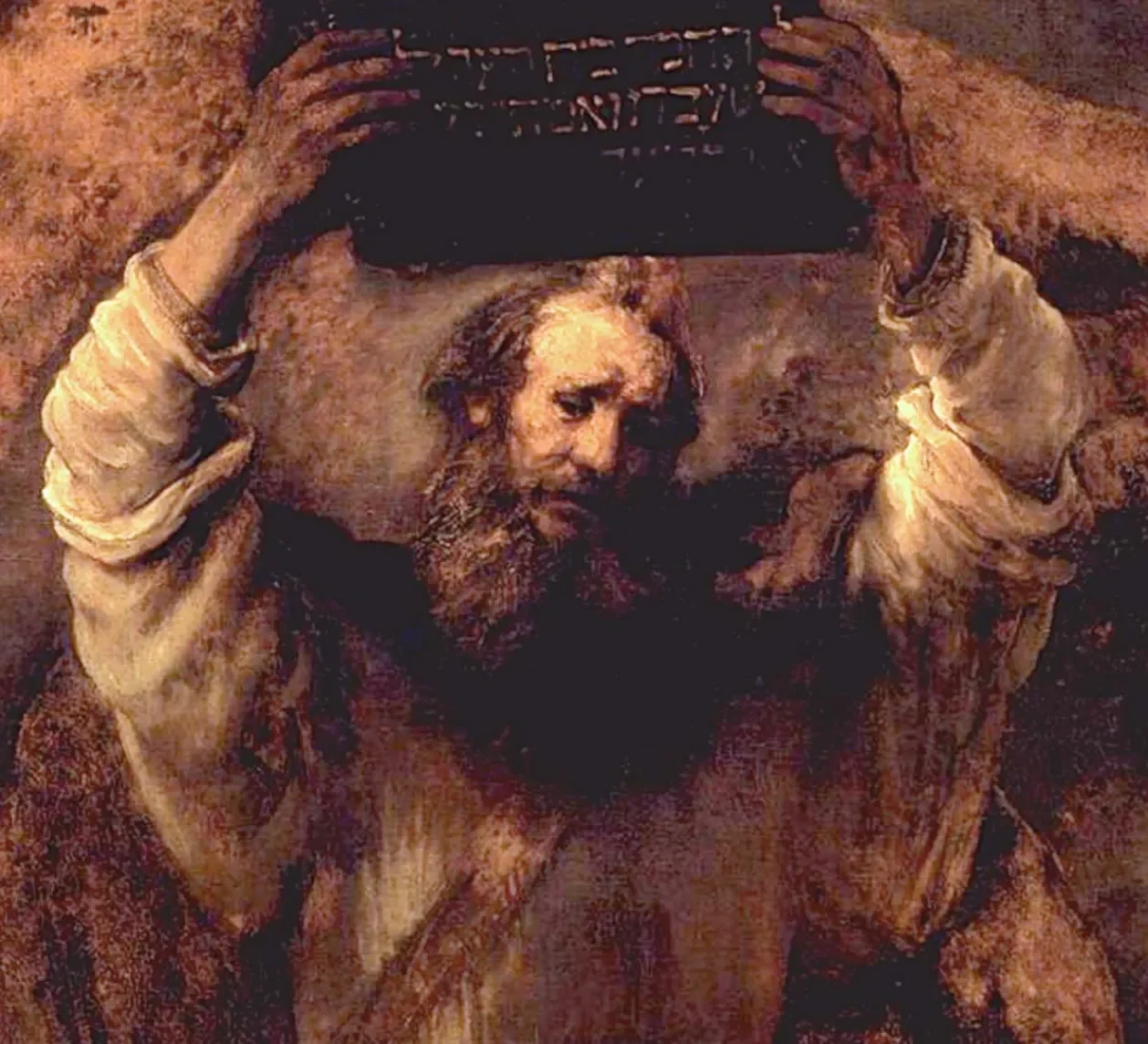
Rembrandt’s “Moses Breaking the Tablets of the Law” (1659) depicts Moses returning with the Ten Commandments only to see that the Israelites had started to worship a golden calf. Full of fury and self-righteousness, driven by a sense of betrayal, Moses smashes the tablets. Future Israeli leaders would display a similar response to disobedience, even if few believed in the Jewish god. As Ilan Pappé notes in Ten Myths About Israel, although Zionist leaders “did not believe in God, He had nonetheless promised them Palestine.”
From a religious and historical perspective, the Passover story is the most important festival in the Jewish calendar. Yom Kippur, the day of atonement, is the main rival in terms of significance, yet there’s no competition because Yom Kippur revolves around questions of individual conduct whereas Passover accounts for the formation of a people and a religion. Also, whereas Jewish Zionists embrace Passover as something that’s essential to their identity, it’s hard to detect the same grouping approaching Yom Kippur with the same level of passion. How many spend the day considering if their support for a country that has ethnically cleansed and genocided the Palestinians is even something to repent? When rabbis address their congregations during Yom Kippur ceremonies they don’t question Israel’s actions. I’ve been following the public statements of rabbis. As far as I can tell there’s not even any cognitive dissonance going down. PS here I’m referring to regular liberal, orthodox and reform rabbis, not the ultra-orthodox, anti-zionist rabbis who proudly and prominently attend the Palestine solidarity demonstrations and stand arm-in-arm with Muslims.
Passover isn’t merely the most important festival in Judaism. Even the story is supposed to have unfolded in West Asia, it forms the foundations of Judaism and therefore also Christianity. Without Passover the core ideas of Christian Zionism wouldn’t have emerged some three hundred years before Theodor Herzl formally established the Zionist movement. Without the Passover story Christian Evangelists wouldn’t have gone on to become the largest grassroots/philanthropic supporters of Zionism and Israel. We wouldn’t have had Tucker Carlson, Charlie Kirk and Candace Owens (even if all three would come to renounce their earlier support for Israel). Nor Mike Huckabee (the current US ambassador to Israel, who hasn’t renounced anything and recently claimed that Israel has a biblical right biblical to land stretching from the Nile River to the Euphrates River!). Without the Passover story Zionist believers Joe Biden, Kamala Harris, Rishi Sunak, Keir Starmer, Olaf Scholz, Friedrich Merz and company wouldn’t have funded and enabled Israel’s genocide of the Palestinians.
It’s not as though any of this was a given. The Exodus story that grows out of the Passover story revolves as much around entering Israel as it does escaping slavery, but it wasn’t until the fourteenth century that the Haggadah introduced the phrase “Next year in Jerusalem”, largely in response to the intensification of Crusader massacres of the Jews. At that point Jews started to understandably long to return to Jerusalem. Yet as Jews became emancipated from ghetto life from the late eighteenth century onwards they overwhelmingly sought not to migrate to Palestine but integrate into their host countries. The phrase “next year in Jerusalem” wasn’t recited as a literal desire. It was more of a symbolic spiritual reference point that is absolutely typical of migrant culture.
Great Jewish thinkers, many of them left-wing, had no desire to move to Palestine, among them Hannah Arendt, Walter Benjamin, Henri Bergson, Sigmund Freud, Emma Goldman, Franz Kafka, Rosa Luxemburg, Karl Marx, Moses Mendelssohn, Albert Einstein, Leon Trotsky and Ludwig Wittgenstein. Baruch Spinoza, who predated the era of emancipation, developed a pantheistic framework that sidelines the traditional idea of the Jewish god and therefore a basic rejection of the tenants of Judaism, for which he was excommunicated. Leo Baeck—the founder of Reform Judaism, the liberal movement that my mum and dad ended up joining because they didn’t like the formal atmosphere at Reading synagogue, which happened to be much closer to where we lived as I grew up—believed that Jews could flourish in the diaspora, embracing host cultures while maintaining their Jewish identity, and so they did, beautifully so. Jewish support for Israel was surprisingly limited until Israel achieved its victory—through what has become a now classic “pre-emptive attack”—during the Six Day War of June 1967. Even the Nazi Holocaust didn’t produce a mass surge in Zionism, which came later. See Norman Finkelstein’s immaculately researched The Holocaust Industry: Reflections on the Exploitation of Jewish Suffering for more on this.
The Exodus also story resonated well beyond Jewish culture, going back centuries. The English Puritans understood their migration to New England in the terms laid out by the Israelite Exodus. Martin Luther led his own Exodus from Catholic corruption. Black salves embraced the Exodus story with spirituals such as “Go Down Moses”. John Milton’s Paradise Lost is saturated in Exodus imagery. Rembrandt depicted the Exodus story in paintings. Yet in these and other expressions Exodus wasn’t understood to be a story that related specifically and exclusively to the contemporary Jewish condition—the allusion was historical. The formation of the State of Israel shifted perceptions of this. For many Jews and Christians it obviously marked the fulfilment of the Exodus story. Then came Cecil B. DeMille’s film The Ten Commandments, released in 1956 and starring Charlton Heston as Moses. Hundreds of millions saw the film and came to understand the Exodus story as “the origin story” of the Jewish people rather than a Christian prefiguration.
From Jewish people gathering to celebrate Passover to DeMille’s Ten Commandments a certain baking in has taken place. According to the narrative, at the heart of the formation of the Jewish people lies the idea of persecution and exploitation (the Israelites were slaves) and the basic justice of a god-led response that was not only brutal and sadistic but also genocidal (if you’re being persecuted its legitimate to respond with maximum force). Scholars estimate that Egyptian families had an average of six children around the time the Israelites are said to have fled Egypt. The God of Israel instructed the Angel of Death to kill one in six of these children. Scholars also estimate the total Egyptian population at the time was between two and five million people. Let’s call it 3.5 million. If the Angel of Death took out one in eight (two adults, six kids) that means the Passover escape rested on the murder of 437,500 children in one night.
(Makes the Gaza genocide look like a walk in the park.)
What do Jews who celebrate Passover make of this scenario? In my limited experience, not much. I grew up in a notably liberal-left humanist household that was also quite secular even if our Jewishness was understood to be important. At the seder table participants are instructed to dip a finger in red wine each time a plague is detailed in the service. The wine is flicked onto a plate or napkin as those present repeat the plagues one at a time. Under no circumstances should anyone lick the finger they dipped into the wine as that would bring the affliction ono that person. We went through the ritual in quite a theatrical, almost camp way, because that’s the kind of family we were (my mum and dad passed when I was young, my uncle and aunt ten years ago). This didn’t amount to a celebration of suffering and death and following the service there would usually be a conversation about the symbolism of the Passover story as well as the politics of freedom in relationship to Israel and Palestine. But it was a holiday gathering, there was a lot more ignorance about Israel’s ethnic cleansing crimes back then, and some pretty weird stuff went down.
Certainly back then—I’m referring to basically 1975-83—most Jewish families were more Zionistic and more rightwing than mine was, so might well have been more gung-ho in their approach. As for today, when the vast majority of Israeli Jews have expressed diehard support for Netanyahu’s destruction of Gaza while diaspora Zionist Jews have been either supportive or incapable of criticising the genocide, it seems the acceptance that the repression and if necessary collective-punishment extermination of perceived opponents is widely accepted.
(I want to be clear that this isn’t the case at all with progressive Jewish groupings such as Na’amod, a movement of British Jews that seeks to end the British Jewish community’s support for the Israeli occupation of Gaza, the West Bank and East Jerusalem, and participated actively in the Palestine solidarity movement along with many other Jewish organisation. I was going to write that sadly Na’amod is fringe, but if we look across to New York 30% of the Jewish community voted for Zohran, who has of course been highly critical of Israel’s genocide. The number of younger Jews rose to 40% We’re not so marginal after all.)
So at the heart of the Passover story lies the idea that the Jews (previously the Israelites) were persecuted from their inception as a people and that the rightful response to persecution involved a naked brutality that culminated with a genocide of Egyptian children.
Similarly impressed into the Jewish psyche is the idea that, even if the facts of the Passover story are hard to establish, on some basic level the storyline is true. Certainly I, a hardline secular socialist Zionist Jew, thought this way.
After my indoctrination-heavy gap year in Israel and also after some of my friends from the gap year experience migrated to Israel, I took to visiting Israel during the summer and made a point of finding time to head solo to the Sinai desert equipped with t-shirts and novels. One time I hiked up Mount Sinai, where the God of Israel is supposed to have handed Moses the Ten Commandments. Tragically the Jewish Zionist successors of Moses ended up losing track of the meaning of “thou shalt not kill”, “thou shalt not cover thy neighbour’s ox, nor his wife, nor his ox nor his ass nor anything that is they neighbours” etc, to genocidal effect. But at the time I was deeply drawn to the idea that I could trace my ancestry back some 3,500 years to the mount that I’d climbed at dawn. I felt comfortable doing this while at the same time holding on to a belief that the only truly just solution to Israel’s displacement of the Palestinians and occupation of Gaza and the West Bank was a single secular democratic state.
For me this just goes to show how deep the mythology ran and clearly continues to run. Later I learned there’s good reason to doubt that a significant proportion of European Jews have any connection to historic Israel; this is one reason DNA tests are basically illegal in Israel. Perhaps more significantly the basic research I’ve just conducted into the Passover/Exodus story reveals the the whole narrative is fictional. In other words, when I sat on top of Mount Sinai thinking back to ancestors who came before me I was engaging in an extreme act of ideological fantasy.
The Book of Exodus claims that 600,000 Israelite men, so probably two million Israelites in total, fled Egypt. (Exodus 12:37: “The Israelites journeyed from Rameses to Sukkoth. There were about six hundred thousand men on foot, besides women and children.”) However, there’s simply no archaeological evidence whatsoever—not even bobkes (“goat droppings” in Yiddish)— that two million Israelites fled Egypt and then wandered around the Sinai desert for forty years, even though two million Israelites could have only left a substantial trail of pottery etc. Nor are there—any— Egyptian records that the Egyptians enslaved the Israelites, even though the Egyptians heavily documented their history. According to the Torah the Israelites crossed the Jordan river to conquer Jericho, this after marching around the city for seven days. It was the first Israelite conquest of Canaan. However archaeologists believe that Jericho was either a small city or even uninhabited at the time. There’s no evidence that it stood as a fortified city that the Israelites then occupied. Tony Greenstein points out in the comments that at the time of the mythological exodus Pharaoh also controlled Canaan/the Land of Israel—so how was that supposed to work for the Israelites?
There are some parallel theories about what might have happened in place of the mythology of the Israelites fleeing Egypt and travelling across the Sinai desert to reach Canaan. One runs that a tiny group of people, maybe the Levites, escaped from Egypt. It’s also possible that the Exodus story was transposed onto travelling of Semitic peoples (or people who spoke Semitic languages, ie not just the Israelites) who travelled to and from Egypt as part of trading activity. But basically the foundational story of Jewish identity and the formation of Israel is pure fiction.
This might not be quite so galling were it not for the simple fact that the mythology of Passover has been used relentlessly by Zionists to persuade Jews of their innate historical and emotional connection to Canaan/Israel/Palestine, or to justify Zionist claims that the Jewish people have some kind of straightforward historical claim to the land. The story is also used to spread the mythology that at the root of their existence the Jews were persecuted and that somehow this basic reality can never be disassociated with the Jewish experience, ie to be Jewish is to face antisemitism. This basic idea that Jewish people face antisemitism has intensified exponentially since Israel began its genocide of the Palestinians.
It’s been shocking to see how many Jewish Zionists are unable to understand the very basic point that criticism of Israel or even support for a secular democratic state, in which Israeli Jews and Palestinians live together with equal rights, has absolutely nothing to do with antisemitism. The only possible conclusion is they can’t understand because they don’t want to understand. Meanwhile hundreds of thousands if not millions of Jews worldwide have attended Palestine solidarity demonstrations, rallies in support of Zohran Mamdani etc and not felt in the slightest bit threatened. In fact Jews who have stood up and criticised Israel’s barbaric behaviour unanimously report that they feel both completely safe in these environments and if anything have experienced a revitalisation in their Jewish identity. They are warmly welcomed, cheered if they speak to the rally. I’ve experienced this repeatedly since attending the first solidarity demonstration in London on 14 October 2023.
Nevertheless on 26 March the Jewish Chronicle ran an opinion piece by the British Jewish (unfunny) comedian Maureen Lipman titled “Does the world have any idea how tired the people or Israel are?” The strap line: “A dear friend told me that his grandchildren have needed to enter their safe room more than 200 times since the current battle began”. This from, of course, a country that has ethnically cleansed and genocided the Palestinians as well as launched a war on Iran and an invasion of Lebanon that’s cost more than 3,000 lives and destroyed more than 100,000 civilian buildings. Yet somehow it’s the Israelis who are tired and suffering.

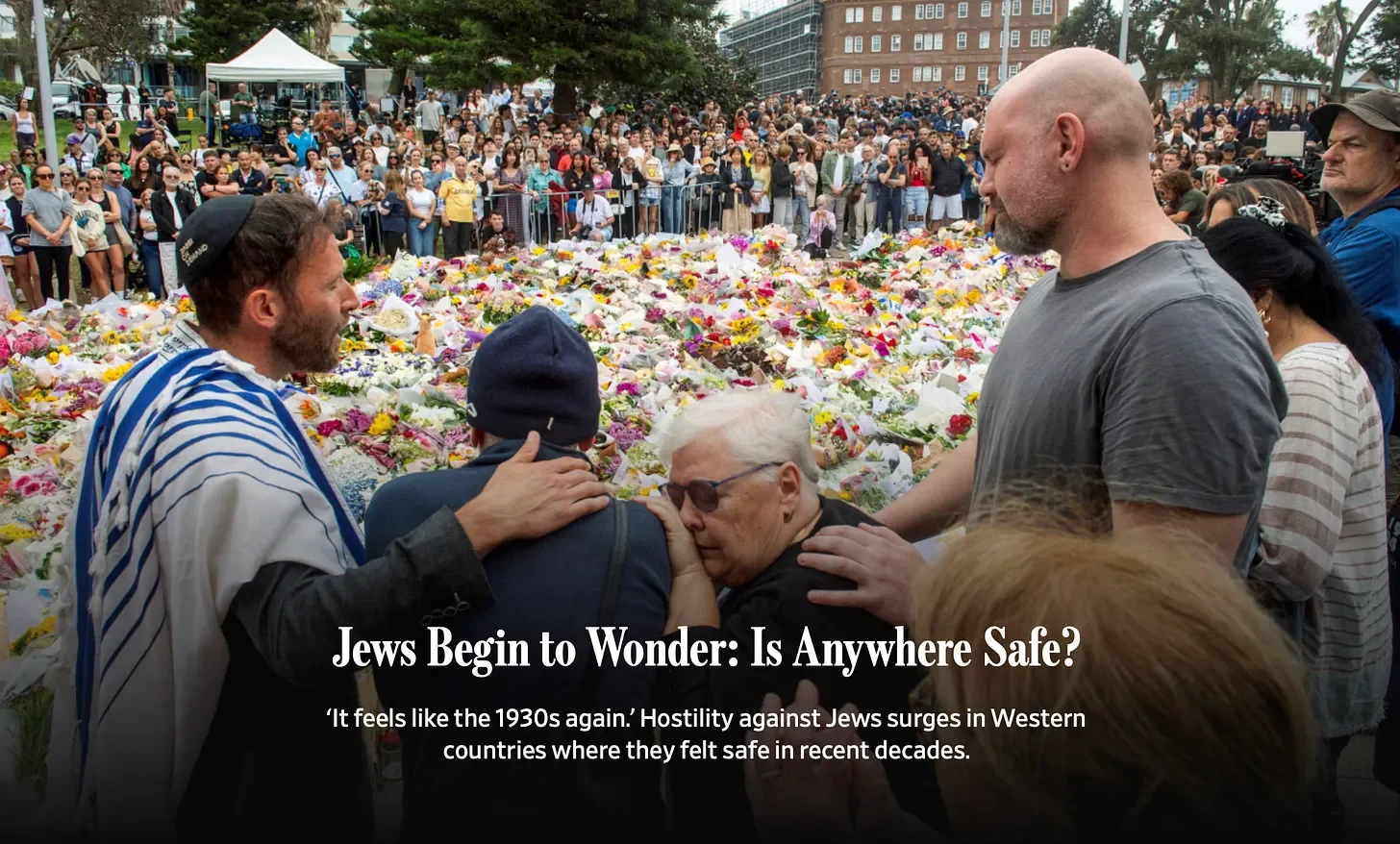
The same day the Wall Street Journal ran a story titled “Jews Begin to Wonder: Is Anywhere Safe?” The strap line: “It feels like the 1930s again. Hostility against Jews surges in Western countries where they felt safe in recent decades.” The underlying arguments was the same as Lipman’s in the JC. As it happens it does feel like the 1930s and 1940s again, not because of antisemitism but because Israel’s genocide of the Palestinians is strikingly reminiscent of Hitler’s genocide of the Jews. (As I feel obliged to say in these moments, my dad was lucky enough to get out of Germany on the kindertransport a month before the start of World War Two.) The WSJ is simply reinforcing one of the biggest lies to have been sold to us in recent times: that criticism of Israel or opposition to Israel’s genocide of the Palestinians is a form of antisemitism. However if anything it’s antisemitic to claim that any Jew who criticises Israel is an antisemite because it implies that Jews can’t be ethical.
Then yesterday afternoon I caught a Netanyahu interview—seemingly not AI—in which he sombrely complained that Iran is attacking Israeli civilian infrastructure, is threatening to attack religious sites etc—this from a psychopathic, lying maniac who has turned the whole of Gaza to rubble, overseen a genocide of the Palestinians that has mainly targeted women and children, and is now openly taking that Gaza playbook to Iran as well as southern Lebanon. More than 110,000 civilian buildings, many of them hospitals and schools, have been targeted by Israel along with its war slave the United States. Netanyahu has also introduced the death penalty for Palestinians convicted of terror charges (as if any Palestinian would ever receive a fair trial) but not Israeli Jews (as if any Israeli Jew would face trial for such a crime rather than be lauded a national hero). It’s the kind of law that not even Hitler introduced (thanks to Tony Greenstein correcting my earlier suggestion that Hitler did introduce such a law in the comments below). But somehow Netanyahu wants us to believe that the problem lies with Iran (which hasn’t initiated a war against a neighbour since the 18th century).
The level of racist denial required to make such a claim is impossible to comprehend and digest. Yet whenever anyone has the temerity to question if Jewish Zionists are the real victims in the room here the Zionist brigade (non-Jewish as well as Jewish) gathers to roll out accusations of… antisemitism. Trump does this all the time, the people around Trump do this all the time, Starmer and his Attorney General Hermer do this all the time, the mainstream corporate media repeat this all the time.
I’m grateful to have escaped this paranoid, self-absorbed, defensive, myopic echo chamber that can only see persecution and is incapable of understanding that people with a moral conscience will criticise Israel and its supporters, whether they’re Jewish or non-Jewish, just as they will criticise any fascistic country. They are also incapable of understanding that if they want Israel to survive they, too, should join the criticism so that Israel is eventually compelled to become a less barbaric state.
This Passover it really struck me that the basic Zionist premise—that Jews are forever persecuted and have the right to respond as brutally as they deem to be necessary without any consequence—all goes back to the Passover story.
End the war on Iran, free Palestine!
xx