Pep Guardiola, genocide and the end of the "Jewish community"
In addition to the genocide Zionism has terminated the possibility of a Jewish community and has no regrets
7 February 2026
The word “community” has long been sucked into liberalism’s fake lexicon of do-gooder, virtue-signalling intent (“I want to imagine I’m part of a progressive community, part of the solution to the world’s problems”) that covers up inaction (“I’m not going to give up any aspect of my privilege or lifestyle to help bring this about”). I’ve been struggling with the abusive usage of “community” in many different contexts for ages now, not quite knowing how to respond, because it’s complicated to challenge something we want to align with. But yesterday’s “Manchester Jewish community” response to Manchester City manager Pep Guardiola’s comments on Israel’s genocide of the Palestinians the day before—he used the correct genocide terminology—turned out to be the tipping point.
An earlier and in many ways more repellant abuse of “community” emerged last year when attendees of the Davos world economic forum started to refer to themselves as a “community” when they transparently constitute a corporate/oligarch power elite. It’s hardly more meaningful to speak of a “Davos community” than it would be to describe Jeffrey Epstein’s business/paedophile/Zionist ring as a community. As tight as they were, as much as they shared a pleasure in variously abducting, luring, exploiting, abusing, raping, torturing, murdering and in some cases eating underage girls, no matter how much they enjoyed doing deals to boost Israel and a thoroughly corrupted corporate system, Epstein, Ghislaine Maxwell, Ehud Barak, Donald Trump, Bill Clinton, ex-Prince Andrew, Peter Mandelson, Elon Musk, Lawrence Summers, Peter Thiel, Steve Tisch, Alan Dershowitz, Jay-Z and the rest formed a exclusive billionaire cabal of grotesque predators, not a community.
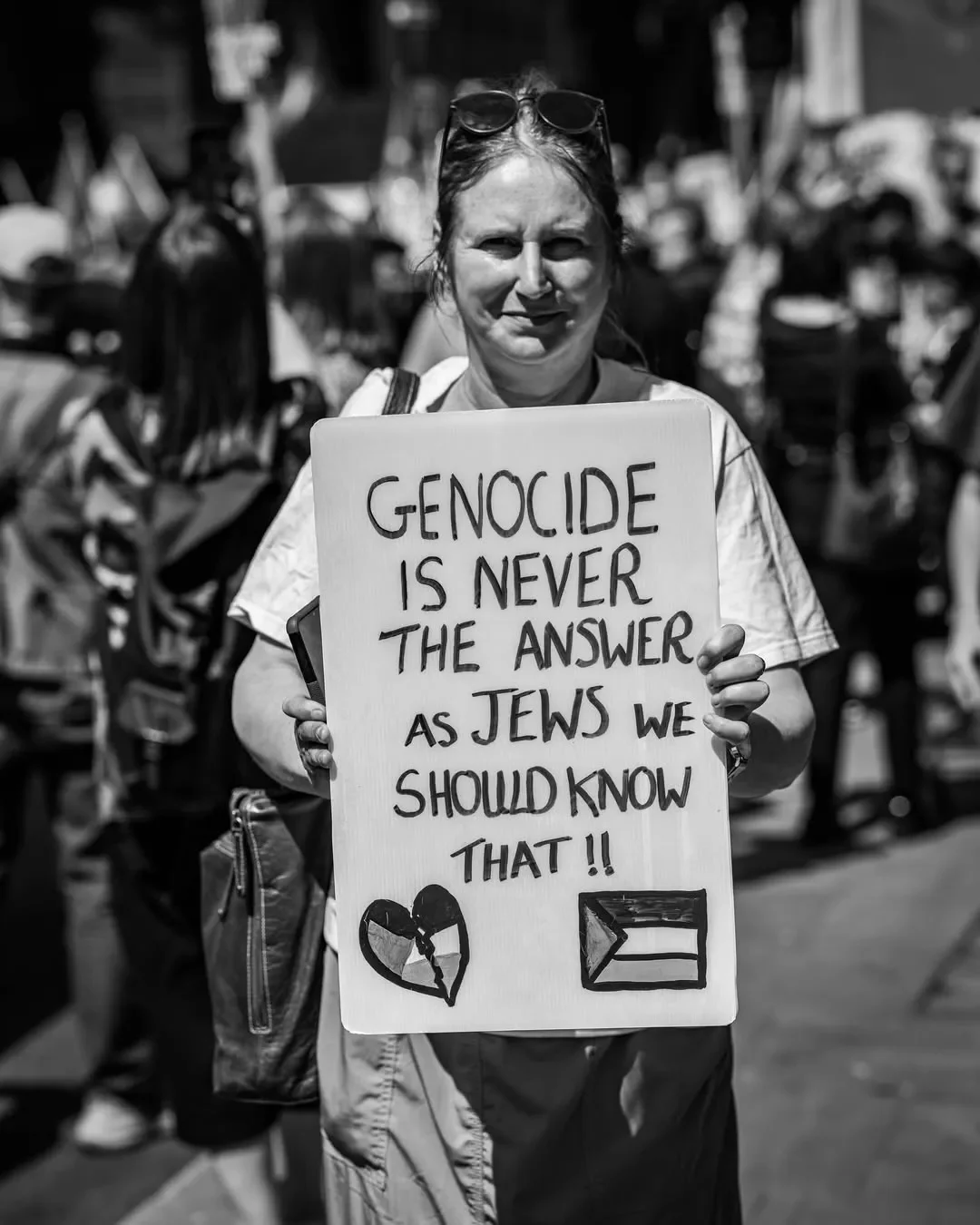
Protestor at the national solidarity rally in London, Saturday 31 January 2026, photo by Misan Harriman
Communities don’t just amount to groups of people who share interests and values while looking out for each other. They also rest on a certain form of behaviour. The starting point of community is care, not just for people within the community but humanity in general, so for a grouping to be a community it has to embed communal values at the heart of its functioning. It’s a caring disposition that extends to others. Communities want other communities to thrive alongside their own community. The European Community isn't really a community because it wants to elevate itself above others and also panders to an internal elite, primarily led by Germany, that priories its corporate power and wealth over other member nation. As with any ruling elite, certain offerings that came with the EU appealed to the region's working people, so the free movement desired by corporate bosses to maximise cheap and flexible labour was also something that many EU citizens enjoy--but the crumbs offered don't amount to a loaf of bread. The innately connected yet even more malignant Davos cabal doesn’t qualify because as jolly as its gatherings might be the group is responsible for destroying communities across the planet. As they do this they raise their collective glass to the wealth and power they’re generating for themselves while wreaking havoc.
And so on to the lapsed “Jewish community”.
The part of the anti-community grouping of Jews that lives in Israel—almost all of them colonial migrants who can’t trace their ancestry back a hundred years, because back in the early 20th century only 5% of the population of Palestine was Jewish—is outwardly more united than ever in its believe that Israel has a “right to exist”, has a “right to defend itself” and has a right to ethnically cleanse as well as genocide the Palestinians. Poll after pool of Israeli Jews reaffirms the strength of nationalist feeling. But scores upon scores of experts, human rights organisations, genocide scholars and so on have long concluded that Israel is perpetrating a genocide against the Palestinians. Is it possible to think of this as a “community-oriented genocide”? Somehow the words don’t sit together comfortably.
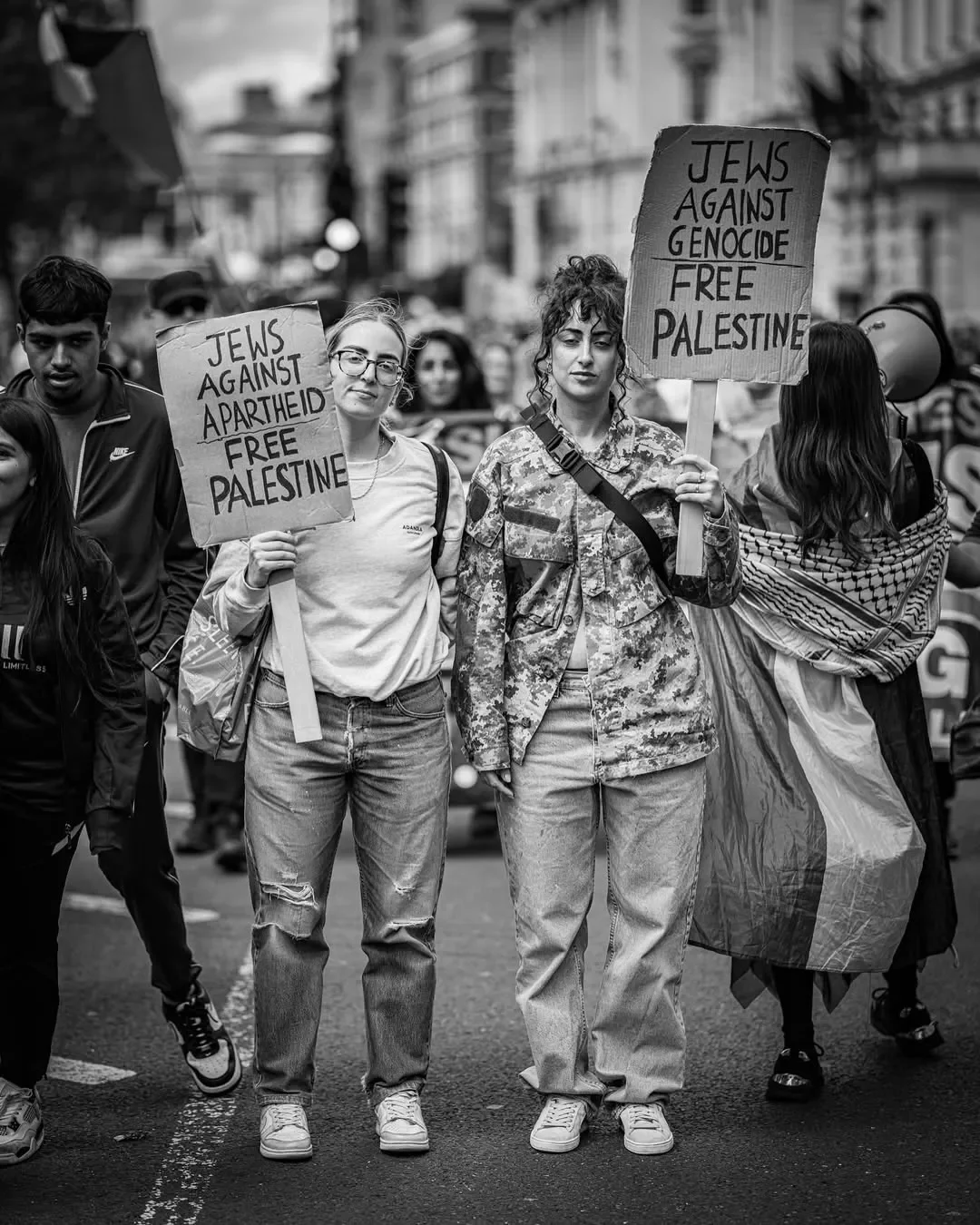
Protestors at the national solidarity rally in London, Saturday 31 January 2026, photo by Misan Harriman
The Jewish community is a funny thing—although not Woody Allen funny, because Allen hasn’t been that funny for a while, really, and certainly not since his deep links to Epstein came to light. Who’d have thought that someone who featured grown men falling in love with underage girls in their movies and married his step daughter, whom he first met when she was ten years old, would be tied to Epstein?
During the 2015 UK general election campaign a Jewish Labour Party friend and high-flying barrister—not the Attorney General Richard Hermer, to be clear—invited me to a fund-raising dinner he’d purchased tickets for. Proceeds would go to the Labour Party, led by Ed Miliband, who was a little bit more progressive than his awkward brother David, a Blairite foreign minister who’d expressed his support for the US-UK invasion of Iraq, which left one million Iraqis dead. The “Jewish community” really disliked Ed. Something like 65% were Tory anyway, just because they saw that as being in their economic self-interest or just trusted the Tories more on Israel, even though Thatcher had introduced an arms embargo on Israel following its invasion of Lebanon—remarkable when we look back on that moment, if only Starmer could manage a hundredth as much in response to a genocide. Anyhow the “Jewish community” really despised Ed because although he was a Zionist Jew he advocated recognition of Palestine along with the vast majority of Labour MPs and countries around the world. In this wobbly fund-raising moment I found myself allocated to sit at a completely Jewish table. In my naivety I hadn’t anticipated this scenario at all. As the grouping hovered, I saw a Hasidic (ultra-orthodox) Jew. Prejudiced about Hasidim at the time, I thought, oh no, I really hope I don’t end up having to sit next to him. Then I found that my name card was placed next to his. Then I sort of fell in love with him. He was funny, sharp, intelligent, open-minded, a representative of the Hasidic community as well as a wider community activist. During the course of a few hours I changed my view of Hasidic Jews. I suspect I ended up having a much more interesting and entertaining evening than would have been the case if I’d sat next to a more conventional Jewish politico, especially considering the major role Labour Jews would play in destabilising Jeremy Corbyn, the leader who succeeded Ed, via entirely spurious accusations of antisemitism. So that was interesting.
The Hasidim are renowned for being tight in communal terms. I’d come across them in different settings, including my early journeys to New York City, which were always on Air India—maybe a quarter of the passengers would be Hasidic—and also when I ventured up to to Stamford Hill, home to one of the largest Hasidic communities in London. During this period I didn’t form a generous impression of their outfits, what I read as their huddled nature, aspects of their traditionalism. In retrospect I was doing a fair amount of liberal projecting and judging, meaning that I thought I was morally superior and that automatically they should adhere to my worldview rather than me to theirs. Then I met the rabbi at the Labour Party fundraiser. My view softened. A couple of years ago I went camping in North Wales with my daughters and Niki Orfanou and to my surprise we kept on bumping into Hasidic hikers. They didn’t change their outfits to hike and climb up mountains, which I liked. They were always friendly. They weren't huddled.
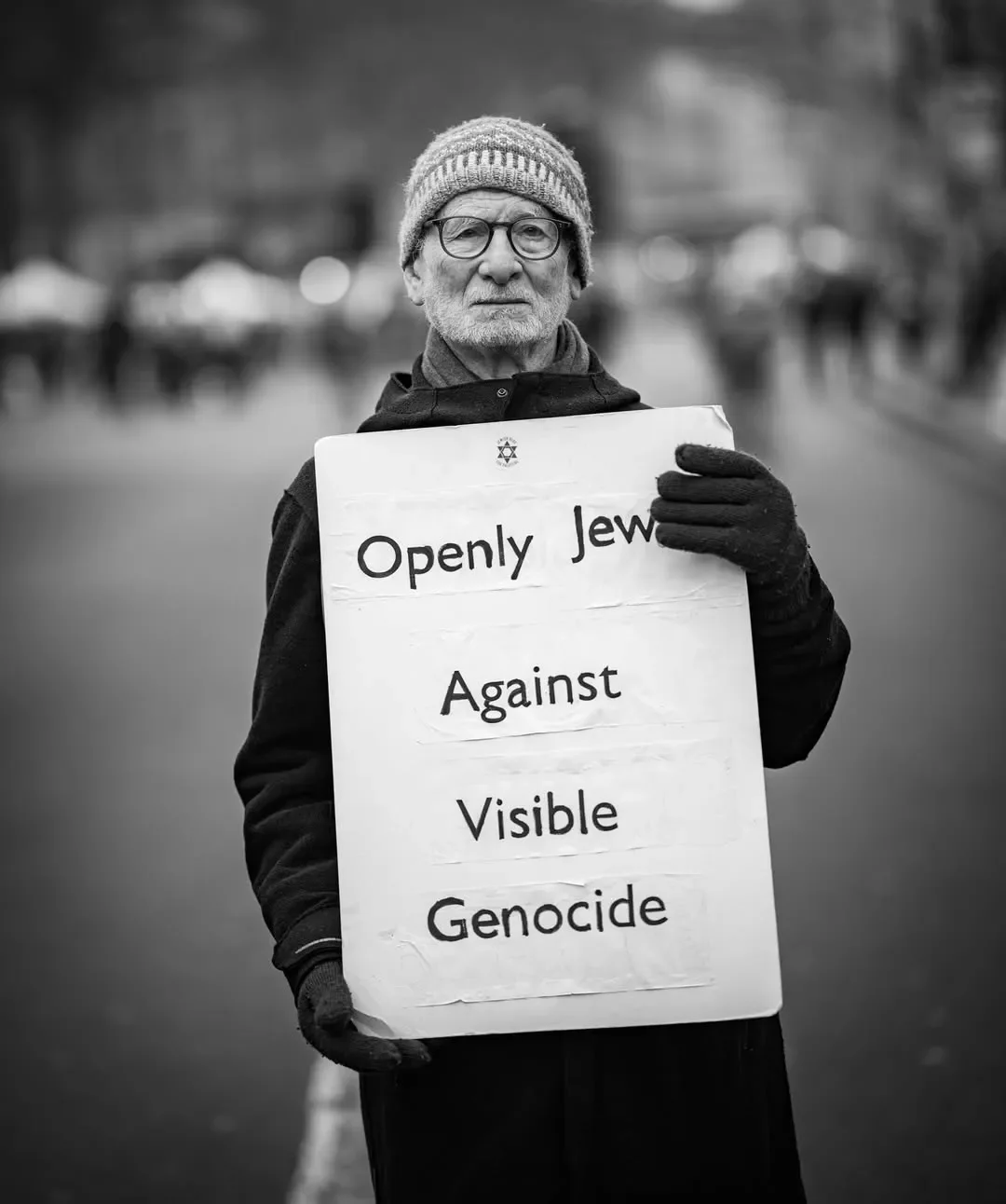
Protestor at the national solidarity rally in London, Saturday 31 January 2026, photo by Misan Harriman
Is it reasonable to speak of an ultra-orthodox community while questioning if there’s a wider Jewish community? Yes, if the Hasidic community views others as potential friends rather than likely enemies, if they’ll have a conversation with you in the queue at the bakery, of course. There are exceptions, notably the Hasidic Jews who’ve colonised the West Bank, exemplified by the terror-Zionist godmother of the settler movement Daniella Weiss, interviewed so brilliantly by Louis Theroux in his documentary The Settlers. Those ultra-orthodox Jewish Zionists can’t form a meaningful community because their worldview is rooted in hate, suspicion, arrogance, superiority, racism, violence and fascism. They’re more of a death cult than a community. But the Hasidic Jews I’ve come across in the UK are entirely different.
To elaborate, one of the things I didn’t anticipate when I joined the first post-7/10 solidarity demonstration was that I would encounter such a strong presence of ultra-orthodox Jews. Again, this was nothing more than a reflection of my own ignorance and prejudice. Understanding their reasoning turned out to be incredibly straightforward and convincing. They argued that Judaism, a religion based in ethics, was antithetical to Zionism, a form of nationalism that’s proven itself to be endemically aggressive. They argued that Jews should only return to Palestine when the Messiah ordains this to happen. They also explained how Christians, Jews and Muslims lived in Palestine peacefully until the Zionist movement formed in the late 19th century and Balfour subsequently handed Palestine to the Jews in 1917, after which successive waves of European Jewish immigration disrupted their co-existence, especially during the 1930s, when Hitler arranged with David Ben-Gurion, leader of the Jewish Agency, for German Jews to go and live in Palestine in return for payments made to ease Germany’s post-World War One debt Everything had been fine, everyone managed to get along, until Zionism barged down the front door.
Zionism can’t support the idea of community because it was born as a colonial ideology rather than as a coming together of people who wanted to work out how they could live together. Indeed for decades, even up to 1967, Zionism wasn’t particularly popular in the Jewish diaspora. Mainly, Zionism always valued the idea of Israel above the welfare of global Jewry.
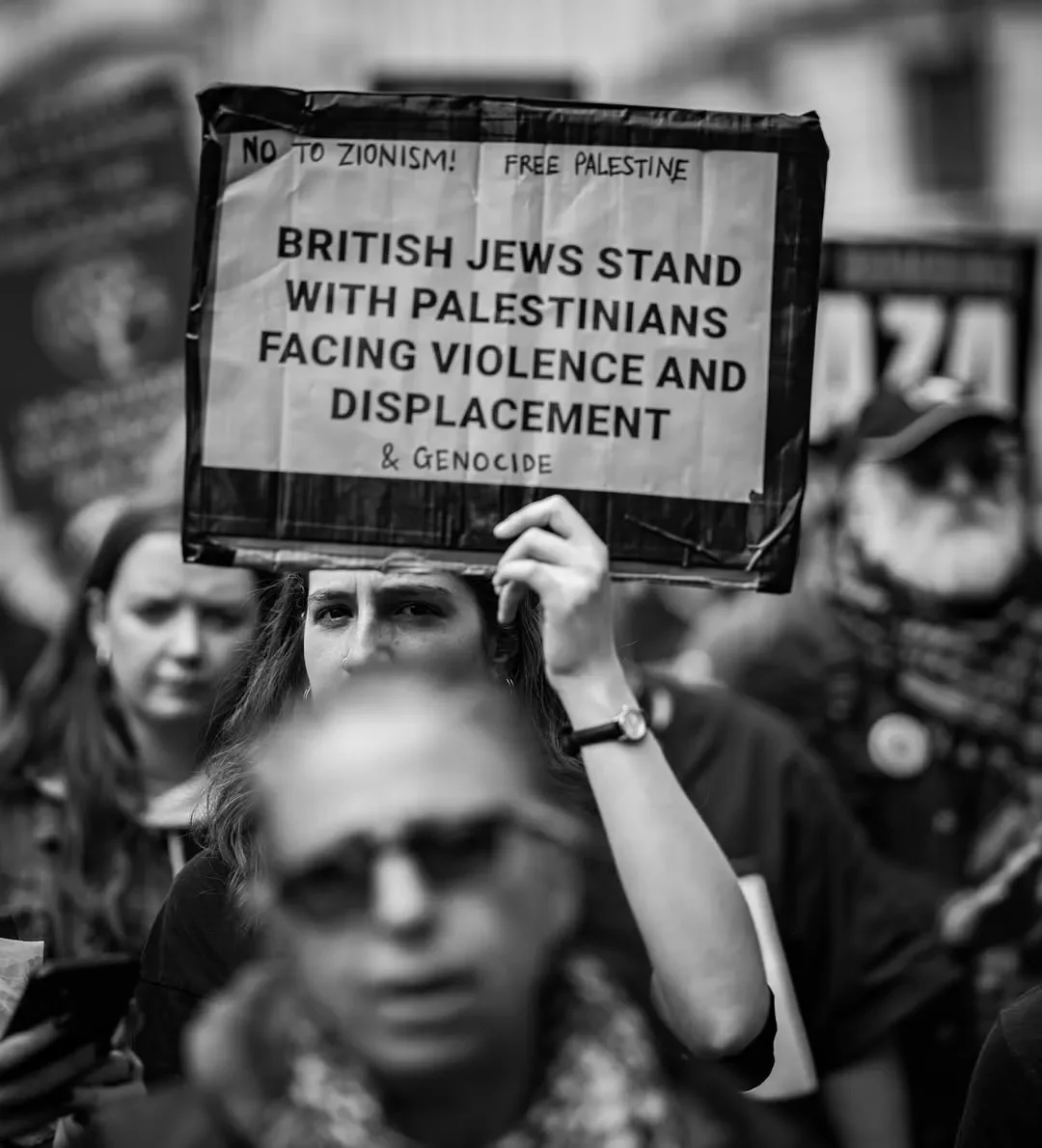
Protestor at the national solidarity rally in London, Saturday 31 January 2026, photo by Misan Harriman
When researching a piece I wanted to write in the aftermath of the Syros solidarity demonstration against the arrival of an Israeli cruise liner in the summer of 2024, which led Zionists to falsely compare our action to the allies who turned away German Jews fleeing Germany on boats, which turned out to be the United States, Canada and Cuba, then a US ally, I learned that Ben -Gurion believed that if he could have arranged for half of the German Jewish children who escaped Nazi Germany on the kindertransport arranged by the allies to instead go to Israel he would have made that choice. In other words, Ben-Gurion was happy for half of the Jewish kids to end up in the gas chambers if the other half went to Israel. My dad was on one of those trains. So at that point I learned that Ben-Gurion, who would go on to become the first prime minister of Isarel, who is widely considered to have been the greatest Israeli leader of all time, only wanted my dad to live if he went to Israel, otherwise his life wasn’t of value. The conclusion is simple and typifies how Israeli Jews and Zionists around the world tend to view Jews. If they support Israel more or less unwavering they’re allies. If they don’t their enemies and can die.
Over the years I’ve heard Zionists recount time and time again how there’s antisemitism everywhere, that the only place Jews are free of persecution is Israel. They particularly love to say how the Muslim world is antisemitic, especially Iran. So I was interested to recently watch a documentary made by the investigative journalist Max Blumenthal, an anti-Zionist Jew and the editor of Grayzone, titled “Uncaptured: Jews in the Islamic Republic of Iran”.
Featuring in-depth interviews with numerous Iranian Jews, the film shows how the Iranian Jew community traces its continuous history back to the Biblical era, something that the Israeli-Jewish community, which was almost entirely exiled for close to two thousand years, can’t remotely do. The film’s Iranian-Jewish interviewees outline the rights and protections the they enjoy in Iran, their devotion to their life in Iran, their commitment to the Iranian state and their deep loathing of Zionism, which they believe is founded on a lie. If a war were to break out between Israel and Iran—it happened not so long ago and might happen again—they would support Iran, no hesitation.
This is just one example of how Zionism perpetually promotes the idea of Israel above the idea of Jewish community, including the right of Iranian Jews to exist independently and happily—an affront to Zionism because it conflicts with their geo-political goals and controlling psychology. The mindset disqualifies Zionists from forming a community because they oppose any community that doesn’t conform to their outlook. In contrast the Iranian Jewish community maintain positive relations with others who are different, including non-Jewish Iranians. In this way they live according to community values.
For a long period it seemed to be possible for the “Jewish community” to exist, if only by a thread. Israel kept getting in the way, as it insisted. During a year-off heavily subsidised by reparations paid by Germany and also Switzerland for its holding of German investments during the Nazi period, but not by the United States for holding its own Nazi investment, payments that were didn’t end up going to survivors of the Holocaust, as intended, but to pro-Zionist organisations, all of this brilliantly detailed and analysed by Norman Finklestein in from Switzerland in his book The Holocaust Industry, I sat next to a guy from the tautologically-positioned socialist Zionist youth movement Habonim Dror during a coach journey to some destination designed to deepen our allegiance. I’d travelled to Israel as part of the Reform Zionist youth movement RSY-Netzer, just because that’s the youth movement that I somewhat randomly became part of, yet had found myself gravitating to Habonim representaiatves. He asked me if I was first a Jew or a socialist. I replied that first I was a socialist because I was first and foremost a human, my Judaism was something I was inducted into. He replied, Well in that case you can’t join Habonim. The delineation wasn’t specifically about Zionism but Zionism shaped his with-us-or-against-us psychology plus for all of us our Zionism and our Jewishness were integrally linked. It was wrong to put humanity first.
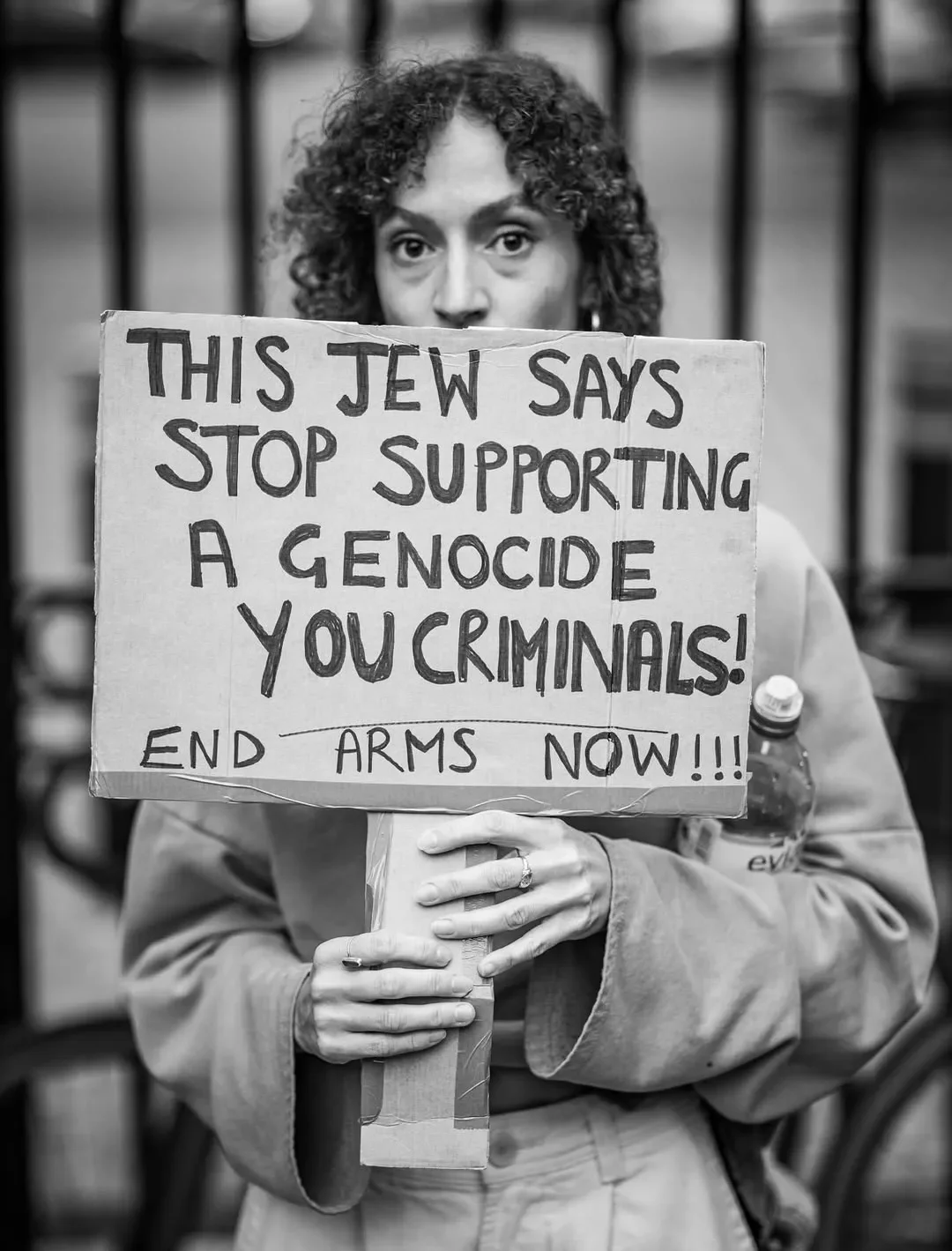
Protestor at the national solidarity rally in London, Saturday 31 January 2026, photo by Misan Harriman
Another example of many: I was very close to my uncle and aunt, both before my dad followed by my mum passed away when I was 19 and then 22, even more so after. They were the sweetest, gentlest, most caring and loving humans, also political progressives on everything except for Israel. Their problem—so many people’s problem—was they’d been systematically fed Zionist propaganda for all of their lives, especially by close friends of theirs who worked for Zionist agencies and fed them a warped version of everything. I challenged the inhumanity of their take on Israel repeatedly, especially as Israel intensified its assault on the Palestinians but got more or less nowhere, even if every now and again they’d acknowledge that, yes, the Palestinians were humans and minimally deserved their own state as part of the much-touted and even supported two state solution. Still, it was an extremely precarious and heart-wrenching exchange and at some point I told them that we shouldn’t speak about Israel anymore, there was no point. I wasn’t proud to drop the discussion but the decision made things easier. There’s no way to transpose a conversation that took place in the early to mid-1990s to now but since the Israeli commenced its genocide in the immediate aftermath of 7/10 it’s become impossible for me and many critics of Israel’s barbaric conduct to park the genocide. I now can’t maintain relations with anyone who thinks there’s no genocide or that it’s an issue that can be parked in the interest of maintaining a friendship.
Tensions have flared, inevitably, painfully, also healthily. On the eve of 7/10 I had five friends who dated back to my time in the Jewish youth movement era, which began when I was fourteen or fifteen and carried through to the year I turned twenty-two, at which point the induction process ended for anyone who didn’t want to become a full-time youth leader. Early into the genocide one of the five, a female friend who’d ended up moving to Israel decades earlier, sent me a text saying that “Israel has a right to exist”, “Israel has a right to defend itself” and “it’s not a genocide”. She ended the friendship. There was no conversation to be had; I was struck by the sheer fervour of her response, which turned out to be merely typical of the vast majority of acquaintances (I can’t use the word “friends”) I made during the youth movement era.
Three other much closer friends, all of whom had developed and retained a much more committed identification with Israel than I’d ever managed, struggled with the calamity of genocide for a painfully long period of time. We’d meet up intermittently, I’d make the case, there were some difficult conversations, some of which broke down completely. I questioned the ethics of maintaining these friendships but also believed in the underlying humanity and rationality of these friends, trusting that over time they would come around to the undeniable truth of genocide and its consequences. Eventually they recognised that Israel has indeed perpetrated a genocide, not necessarily because of our discussions, although it’s possible they played a part.
The final friend, now an ex-friend, is the Attorney General Richard Hermer. Our friendship is too complicated to get into here, but the core of the story is that Hermer, no longer Richard or Rich to me, switched from living the life of a left-wing human rights lawyer to accepting Keir Starmer’s offer to become Attorney General—against my pre-election advice—and has played a major if not decisive role in the UK’s active support of Israel’s genocide. Hermer has without doubt been advising Starmer on the feasibility of denying that Israel has committed a genocide, which under the Geneva Convention carries huge implications for governments that provide Israel with military weapons, spying information and diplomatic support, as the UK has done unerringly. As a result, even if Hermer offered a more critical view of Israel during the post-7/10 period, and had earlier argued that Israel’s occupation of the West Bank amounted to apartheid, there was a categorical distinction to be made between friends who were struggling to come to terms with the genocide and Hermer, who as a human rights lawyer was professionally required to acknowledge the genocide and, more importantly, was playing an active role in its continuation.
I last saw Richard a year ago when I told him that he should resign as a matter of principle, immediately, before his reputation was irretrievably trashed for life. At least if he resigned he could step away from the moral abyss and play a role in stopping the UK’s relentless support. Following our half-hour lunch I continued to try to continue the conversation with him, believing that it was more important to try to influence him than end the tenuous friendship. However he didn’t reply to any of the numerous emails I sent him in the aftermath of that lunch, which indicated that he wanted to end the friendship. That was a regret, even if it had already become impossible to maintain amicable relations with someone who I considered to be a war criminal.
What does this imply for the concept and practice of “Jewish community”? This is a tricky area but I think it’s useful to be able to hold certain tensions and disagreements within a community, even profound ones. At the same time there are certain lines that can’t be crossed and the ultimate line revolves around genocide. If the three friends in question hadn’t over time acknowledged the genocide then there couldn’t have been a way to maintain the friendships. For me and I’m sure millions if not billions of others, friendship can’t survive outright denial or complicity or support. Nor can groupings that support a genocide be a community.
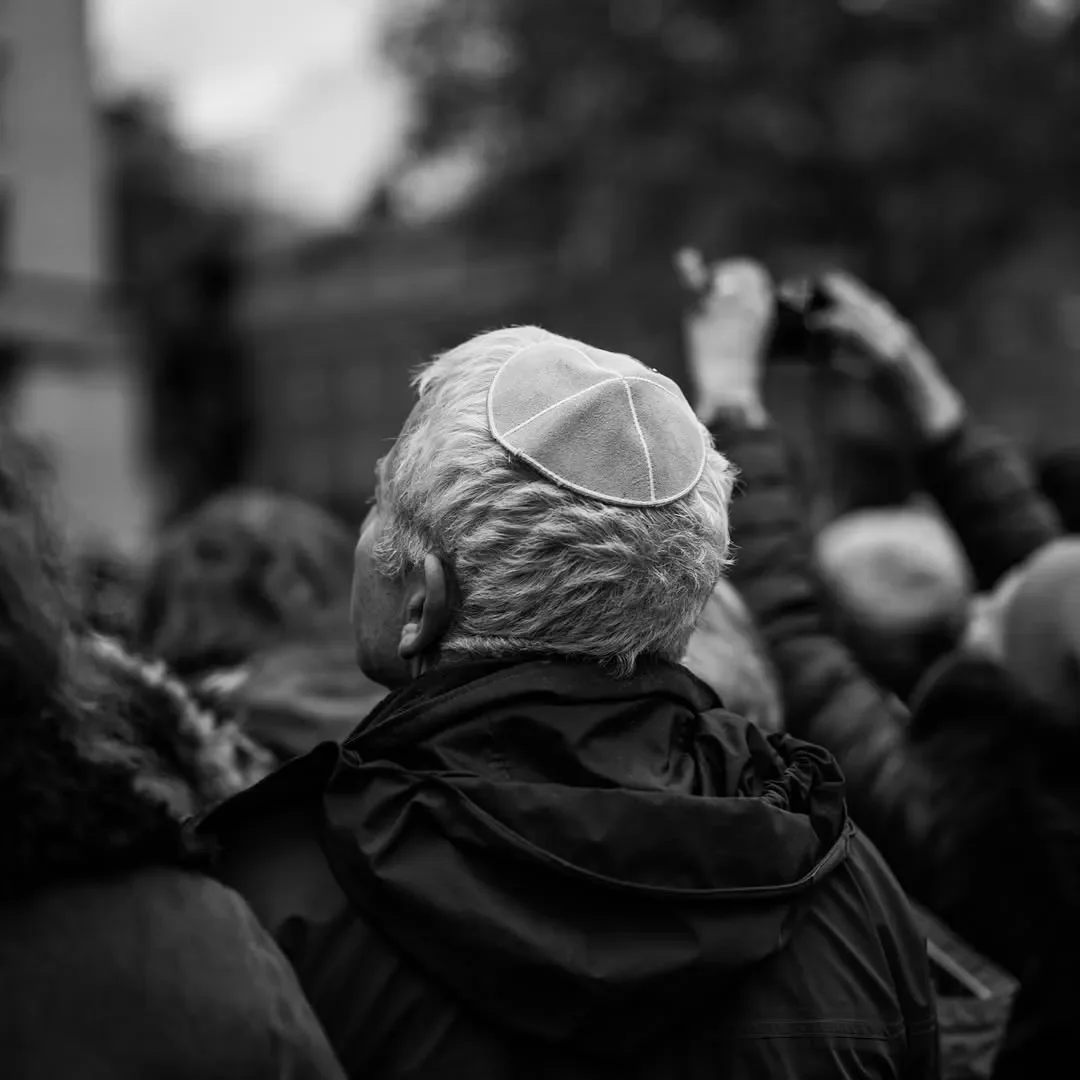
Protestor at the national solidarity rally in London, Saturday 31 January 2026, photo by Misan Harriman
And so to Guardiola…
In a strange coincidence, one of the three friends who’ve come around to acknowledging Israel’s genocide has long been an admirer of Guardiola, whereas I’d been more sceptical of his achievements and even what he seemed to represent as a human. I wasn’t the first person to point out that Guardiola he’d succeeded at incredibly wealthy football clubs, pioneered a robotic style of possession football, seemed to be a bit robotic himself, and so on. But a little while ago Guardiola started to speak out on Israel’s genocide, which caught my eye, because many famous people have remained silent, especially but not only in football. Then, earlier this week, Guardiola made an concerted contribution in which he noted Israel’s genocide pained him in ways that he found unbearable. He also cited other populations that are suffering brutal repression. He felt a duty as a human who held a position of public responsibility to “speak up”. I thought, well done, Pep, I got you all wrong. I sent the report of Guardiola’s comments to my friend and acknowledged that he’d been right about the Manchester City coach from the start.
Then, to my deep embarrassment and horror, the Jewish Representative Council of Greater Manchester and Region weighed in to tell Guardiola that he was wrong to say anything, should be very careful about stirring up antisemitism and should refrain from making any further comments about Israel and Palestine, restraining himself to only talk what he knows about, which is football. “We have repeatedly asked for prominent individuals to be mindful about the words they use given how Jewish people have had to endure attacks across the globe,” ran the statement posted on X read. “Pep Guardiola is a football manager. Whilst his humanitarian reflections may be well-intentioned, he should focus on football. Manchester City is being let down by him repeatedly straying into commentary on international affairs.”
I find it easy to understand how Manchester Jewish representatives remain wary of antisemitism, especially following the brutal antisemitic attack that took place on Heaton Park synagogue last October, when two Jews were killed—one, incidentally, by a police officer—and three others were seriously injured. What I can’t understand is why the Manchester Jewish representatives believe that the cherishing and protection of Jewish life should exclude the cherishing and protection of other life, including Palestinian life, to the extent that nobody should bring attention to the genocide, in which minimally 72,000 Palestinians have been slaughtered, the vast majority of them children and women, with tens if not hundreds of thousands more believed to be lying dead under the rubble of Gaza or to have died through the systematic destruction of Gaza, which has led untold numbers of additional Palestinian deaths, including at least ten babies who’ve frozen to death this winter due to a lack of shelter along with Israel’s refusal to honour the ceasefire agreement with the Palestinians.
I just can’t get my head around this. To me it’s utterly inconceivable that someone who identify as a human can think this way. The only conclusion is that people don’t have an understanding of humanity and therefore community, of the responsibility we all have to human welfare, including the need to call out a crime when we see one, especially a crime against humanity. They’re part of a blinkered cult in which basic decency has been completely sacrificed.
An equivalent scenario unfolded when two gunmen murdered sixteen Jews who were celebrating Hanukah on Bondi Beach in Sydney last December. It’s hard to imagine what it must have been like to be caught up in that massacre, to witness loved ones die that way. At the same time it was impossible to avoid noticing how the plaudits that Zionists, non-Jewish as well as Jewish, showered on the hero who intervened to stop the attackers, saving an untold number of lives before he was shot five times, ground to an immediate halt when it became known that the hero was a Syrian-Muslim shop owner called Ahmed al-Ahmed. What kind of psychology dictates that someone can only be thanked if they’re not a Muslim? What kind of editing has been carried out on Wikipedia to make sure that one has to read some way down the page that describes the Bondi Beach massacre before reading the name of Ahmed, a true hero? I can’t get my head around this.
I feel ashamed of this kind of behaviour, this separating out of humans who deserve to be honoured as humans and those who don’t, those who should be treated with gratitude and respect and those who deserve to be erased. No doubt present before 7/10, this kind of thinking has become rampant ever since. The same outlook has reared itself incessantly ever since Zohran Mamdani announced that he wanted to become the Democratic candidate for the mayoral elections in New York. Zionists, again Jews and non-Jews alike, issued endless warnings that Zohran was dangerous and that his very existence threatened to unleash a devastating wave of antisemitism in New York, where the same group now maintain it’s no longer safe to live a Jew, just as it’s apparently not safe to be a Jew anywhere in the world other than Israel. The simple fact that Israel is the least safe place in the world for a Jew to live, and has become a primary cause of the recent rise of antisemitism, the precise nature of which is hard to determine because Zionists routinely and falsely collapse criticism of Israel and anti-Zionism with antisemitism, goes unmentioned, because Zionism and the Israeli terror start are the world’s perpetual victims. This hyperbolic, melodramatic, self-absorbed thinking continues to spread seemingly unhindered within the “Jewish-Zionist community”.
In combination these developments mark a decisive turn in the identity of the Jews as the self-described “people of the book”—a people proud of its rootedness in historic talmudic study of the Torah and the vast interpretative document know as the Talmud, the culture of which is believed to have resulted in the significant number of Jewish radicals that emerged especially in the second half of the 19th century and the half of the 20th century—as well as a grouping that is grounded in the basic ethics of the Ten Commandments, including the commandments though shalt not kill and though shalt not covet thy neighbour’s house, nor his ox, nor his ass, nor anything that is they neighbours—which was can assume must also include thy neighbour’s hospitals, schools, farming land, roads, institutions, places of worship and wholesale infrastructure. How have the Jews taken these fundamental constituting elements into account and concluded that the only lives that matter are the lives not even of Jews but Jewish Zionists? Only anti-intellectual, anti-ethical thinking can reach such a conclusion. How can they delude themselves that the thirty percent of New York Jews who voted for Zohran, or the forty percent of young New York Jews who voted for Zohran, are all wrong, deluded, antisemitic? It’s properly incredible, meaning impossible to believe.
There is only one culprit in the room: Zionism. There has been a Zionist takeover and its achieved its hegemony over so many Jews as a result of systematic funding and politicising, in which almost certainly trillions have been invested, thanks in part Zionism’s takeover of the corporations and governments of the Western world. To me it’s also incredible that so many Jews have been seduced into this way of thinking.
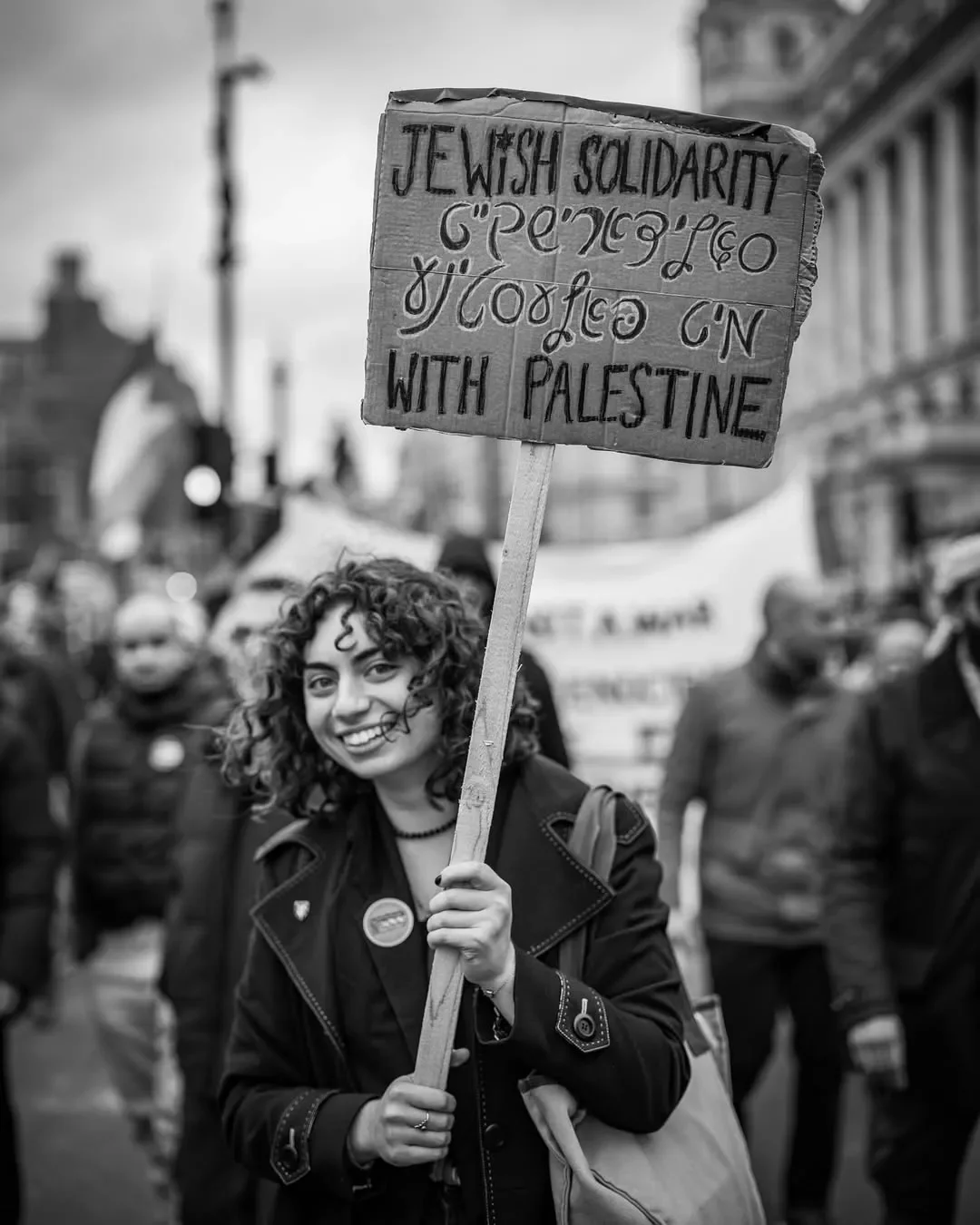
Protestor at the national solidarity rally in London, Saturday 31 January 2026, photo by Misan Harriman
Ultimately the achilles heel of Zionist Jews is that they’ve been seduced by power conferred upon them by Zionism, which Norman also charts in The Holocaust Industry, and don’t what else to do but to cling to it, even though Israel’s status is highly precarious at this stage of the cycle—an argument convincingly put forward by the Israeli historian Ilan Pappé, now based at the University of Exeter in the UK. They’ve also been encouraged to believe that they’re special. The most obvious source of this sensibility is the Biblical myth that god chose them, making them special. Centuries’ worth of antisemitism led to Jews being cast as outsiders, which generated a sense of difference that became an important incentive to survive, contributed to this sense of difference. The Christian evangelical support for the idea that the Jews are special—specifically that for evangelists Jesus will only return once they all fulfil their destiny to return to live in Israel. Jewish Zionists have happily accepted this money even though they know that if Jesus ever returns the Jews will be forced to convert or exterminated. They’re not bothered, they don’t believe Jesus was ever the son of god. Meanwhile Zionists in general and Israeli Zionists in particular don’t believe in the Jewish god—except that bit where god says they’re chosen.
The historical calamity is that European and US Jews were happily assimilating into their host countries and show very little interest in Zionism until Zionists weaponised the Nazi Holocaust. Even then, remarkably, Zionism didn’t gain in popularity until after the Six Day War of 1967. Norman also covers this forensically and brilliantly in The Holocaust Industry. Two decades later, my involvement in the Jewish youth movement led me to be constantly exposed to the idea that Jews are somehow superior, although the idea only really gained traction during the gap year in Israel. Going through five months of intensive study in a Jerusalem-based “study” institute followed by five months on kibbutz amounted to an intense period of reconditioning and became a formative if ultimately transient. I enjoyed a reset when I went to live in New York in 1994 and quickly found that the new friends I was making weren’t Jewish. There was no deliberation going on, it just turned out that way, was intuitive. The roots of this development can really be traced to my immersion in London dance culture in 1991. I loved being part of a community where everyone was welcome. It now sounds slightly weird to say that I even felt this was a place where I felt most comfortable as a Jew, in a truly open and mixed community. But even during the year in Israel I always believed that the truly just solution to the Israel-Palestine “conflict”—a conflict initiated by Zionism—was was a single democratic state. That remains the only sustainable and humane solution, that Jews and Palestinians live side by side in peace. Right now it’s extremely difficult to foresee Jewish Zionists coming round to this way of thinking but it’s the only just and sustainable outcome, plus at some point Israel won’t have a choice, it’s as simple as that.
The conclusion I draw from all of this is that it’s no longer possible to talk of a “Jewish community”. There is a complete and currently unbridgeable divided between Jews who think that the only lives that matter are Jewish Zionist lives and those who value all human life. These two groupings are not part of one community. Indeed Jewish Zionists don’t even believe in the “Jewish community anymore”. They despite Jews who are consistently and ethically critical of Israel. They constant call us antisemites. They’ve also rooted their entire identity into a demonstrably genocidal state. It’s not a healthy place to occupy. They’ve lost the plot, made a calamitous error of judgement, because physics teachers us that actions have consequences and that what goes up must come down.
The rump of Zionist Jews who undoubtedly believe that they constitute the “Jewish community” and the rest of us are rogues who’ll disappear through assimilation are deluding themselves. Thanks to colonialist, murderous Zionist behaviour that long predates the creation of the State of Israel, over time it’s become ever clearer that it’s not only possible but also necessary for ethical Jews to develop a way of being that’s either non-Zionist or anti-Zionist. If many of us were already going down this path long before 7/10—I signed up to the BDS academic boycott in 2015—the growth of this form of Jewish identity has been gathering exponential momentum. There’s been a true renaissance in non and anti-Zionist identity during the last couple of years. You see it wherever you turn on the solidarity demonstrations, on social media, at cultural and political events, in birth of new organisations. This way of being has gathered momentum and belief in the most horrendous circumstances possible, yet it’s the horrendous circumstances that have been the driving force. The percentage of young Jews in Europe and US who are openly critical of Israel and the genocide is phenomenal. Thanks to Israel, Zionism can only shrink.
Sometimes I wonder what might have happened if the Zionist movement had made a concerted effort to live peaceably with the Palestinians, grant them a state, everything it took. Right up to the end of the 1970s, I believe, leftists around the world hailed Israel for the kibbutz movement—even though the kibbutzim operated on stolen land. Given everything, Israel was granted an incredible opportunity to live alongside the Palestinians. Arguably the Zionists were never interested in going down that route. The Six Day War and the subsequent occupation of East Jerusalem, Gaza and the West Bank was a key turning point.
So, in a nutshell, there is a Jewish community, it’s just diametrically opposed to the Jewish-Zionist anti-community cult that thinks that only Zionism matters.
Documentary evidence comes in the form of photos taken by the incredible Misan Harriman at the national solidarity rally in London that took place on Saturday 31 January 2026.
Free, free Palestine!
🇵🇸🇵🇸🇵🇸 🇵🇸🇵🇸🇵🇸🇵🇸🇵🇸 🇵🇸🇵🇸🇵🇸🇵🇸🇵🇸 🇵🇸🇵🇸🇵🇸🇵🇸🇵🇸🇵🇸🇵🇸🇵🇸 🇵🇸🇵🇸🇵🇸🇵🇸🇵🇸 🇵🇸🇵🇸🇵🇸