Ending the UK's support for genocide, weaponisation of antisemitism and neoliberalism
7 May 2026
Today is a big day for anyone in the UK who wants to bring an end to Starmer’s support for the genocide, weaponisation of antisemitism and acceptance of neoliberal inequality!
Back in 2015-19 Zionist and neoliberal interests aligned around their need to discredit Jeremy Corbyn’s Labour party, which was critical of Israel and also promised to reverse the disastrous privatisations of electricity, gas, the railways, royal mail and water. In order to undermine Jeremy’s credibility and puncture his contagious popularity they relentlessly and falsely smeared him as an antisemite.
During the last two-and-a-half months Zionist and neoliberal interests have aligned around their need to discredit Zach Polanski’s Green party, which has been critical of Israel and is also promising to reverse the disastrous privatisations of electricity, gas, railways and water—with royal mail to follow at a later date. To undermine Zach’s credibility and puncture his contagious popularity they relentlessly and falsely smeared him as being soft on antisemitism.
There are differences in the way the corporate-political-Zionist establishment has weaponised antisemitism during the two periods—and also in-between—in order to prevent anything that resembles real change from happening in relation to the UK’s relationship with Israel as well as the basic structuring of its economy. Yet the underlying scenario and strategy is remarkably similar.
There are many ways we can express our opposition to Israel’s ethnic cleansing and genocide of the Palestinians as well as rampant inequality and the concentration of economic power. We can boycott, divest, demonstrate, leaflet, and spread ideas on social media, We can engage in sit-ins, lock-ins and other forms of civil disobedience. We can redirect our energies from the privatised to the social sphere. We can relate to the most basic human activities—breathing, thinking, walking, talking, smiling, dancing, painting—as small acts of liberation.
We can also vote, and in the local elections being held in England, Scotland and Wales today I’ll be voting Green as the most effective way to kick out Labour. I’d encourage you to also vote for whichever party has the best chance of defeating Labour/the Conservatives/Reform—and not let the reigning establishment hysteria obscure what we need to do.
The weaponisation of antisemitism is as old as Theodor Herzl’s Jewish-Zionist movement (but not the Christian Zionist movement). Herzl was rightly concerned about antisemitism: he witnessed the election of an openly antisemitic mayor in Vienna in 1895 as well as the Dreyfus Affair, where a French Jewish army officer was falsely convicted of treason. But just weeks after the first Zionist Congress convened in 1897 Herzl published “Mauschel” in which he characterised Jews who didn’t support Zionism as Mauschel, a slur for a “haggling Jewish trader” that denoted swindling, duplicitous, greedy, cowardly, dishonourable behaviour. Herzl added that non-zionist and anti-zionist Jews are physically repulsive and psychologically deformed.
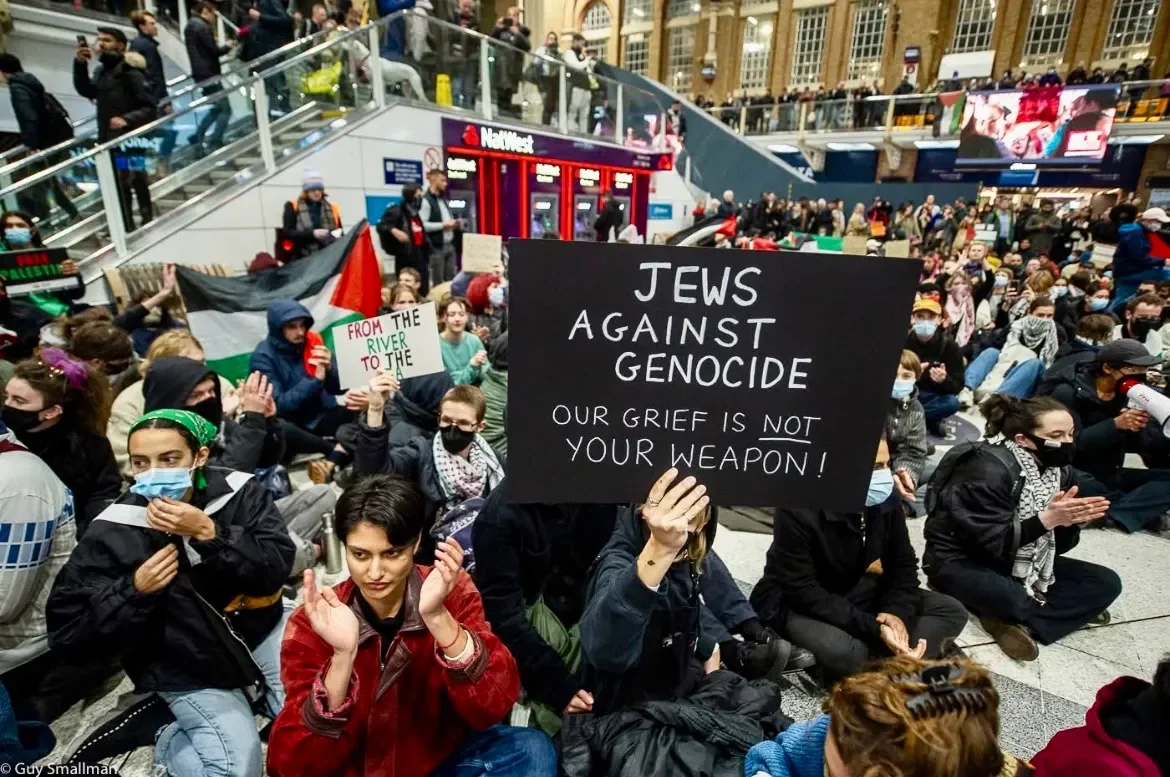
There’s been much grotesque antisemitism since then. Diaspora Jews and other citizens have devoted themselves to fighting it. However non-Jewish and Jewish Zionists whose commitment to Israel happens to be greater than their commitment to anything else—including the Jewish diaspora—routinely regard antisemitism as an opportunity to demonstrate the need for Israel to exist as the basis for Jewish survival. The more Israel becomes the least safe place on the planet for Jews to live, the more Israel’s conduct becomes the source of new antisemitism, the more they demand support for and subservience to Israel. It might not appear to be very clever but Israel has helped tech/AI and military weapons become the most profitable sectors in the US economy between 2023 and now. Israel’s stock market has risen by 99% since 7/10.
The most horrendous expressions of antisemitism, including the Nazi holocaust, which my dad escaped when he left Germany on the eve of the Second World War, can be used to buttress support for Israel. (Jewish New Yorker Norman Finkelstein’s thoroughly researched The Holocaust Industry provides a compelling analysis.) When antisemitism doesn’t exist in any detectable form, as has been the case on the solidarity demonstrations—attended by tens of thousands of Jews, myself included—it gets to be invented to buttress support for Israel. More resources have been devoted to persuading governments and corporations of the inviolable righteousness of Israel than any other cause—in particular in the US, the UK and the rest of Europe. AIPAC and ELNET (European Leadership Network) are the most prominent advocacy organisations of many. No other lobby group comes close to rivalling the Israel lobby in the US.
The influence of Zionism runs deep in the UK. Now is not the place to get into the details. Remarkably the last government to take some kind of stand against Israel was the first Margaret Thatcher government, which banned arms sales to Israel after its 1982 invasion of Lebanon. The embargo remained in place until 1994. Thatcher also clearly denounced Israel’s bombing of Iraq’s Osiraq nuclear reactor in 1981. She was pro-Israel but believed the country should adhere to at least some moral standards. Unfortunately the current UK government, run by proud, unyielding Zionists Keir Starmer, Richard Hermer, David Lammy and Yvette Cooper—Starmer and Hermer have extensive Jewish family in Israel and Hermer has family members serving in the IDF—lack Thatcher’s clarity. As it happens I grew up with Hermer in a Jewish-Zionist youth movement. We routinely expressed our disgust for Thatcher. Now I admire Thatcher more than I admire him—which isn’t saying much given that I continue to hold Thatcher in contempt.
Both Starmer and Hermer dropped any meaningful criticism of Israel as they climbed to Labour leader/UK prime minister and Attorney General respectively. Longstanding close friends from Doughty Street chambers, where they both worked as barristers, Starmer moved first, building his whole campaign to become Labour leader on the promise of getting rid of antisemitism in the Labour party that basically didn’t exist (I’ve done the reading). As prime minister Starmer appointed Hermer and together they revived funding for UNRWA and sort of said they might possibly arrest Netanyahu under the ICC ruling if he came to the UK. A handful of weapons contracts were cancelled.
Beyond that Starmer, advised by Hermer, has overseen a massive increase in the supply of military weapons to Israel, provided Israel with 50% of the spying information conducted over Gaza, maintained active diplomatic relations with high-ranking Israeli politicians and IDF chiefs, and gone further than any government in UK history when it comes to clamping down on the solidarity protest movement. Like Zionist robots they only deliver monosyllabic rebukes to Israel when—during their sponsorship of a genocide—they’ve had no choice but to do otherwise. The fact that Starmer and Hermer both made their way in life working as human rights lawyers merely illustrates the epic scale of their moral collapse.
It’s been awkward for Starmer to express his support for Israel during its genocide of the Palestinians, invasion of Lebanon and an unprovoked war on Iran. But then the thing with Starmer is he’s not really able to speak with conviction about anything because he doesn’t have any convictions, he’s a vacuum of a human being. One of the very few topics when he speaks with something akin to a belief or moral conviction is when he’s making the case for supporting Ukraine militarily against Russia—where he aligns seamlessly with the Foreign Office’s longstanding hatred of Russia, which goes back to the early 19th century. The other topic where Starmer appears to speak with moral conviction is antisemitism.
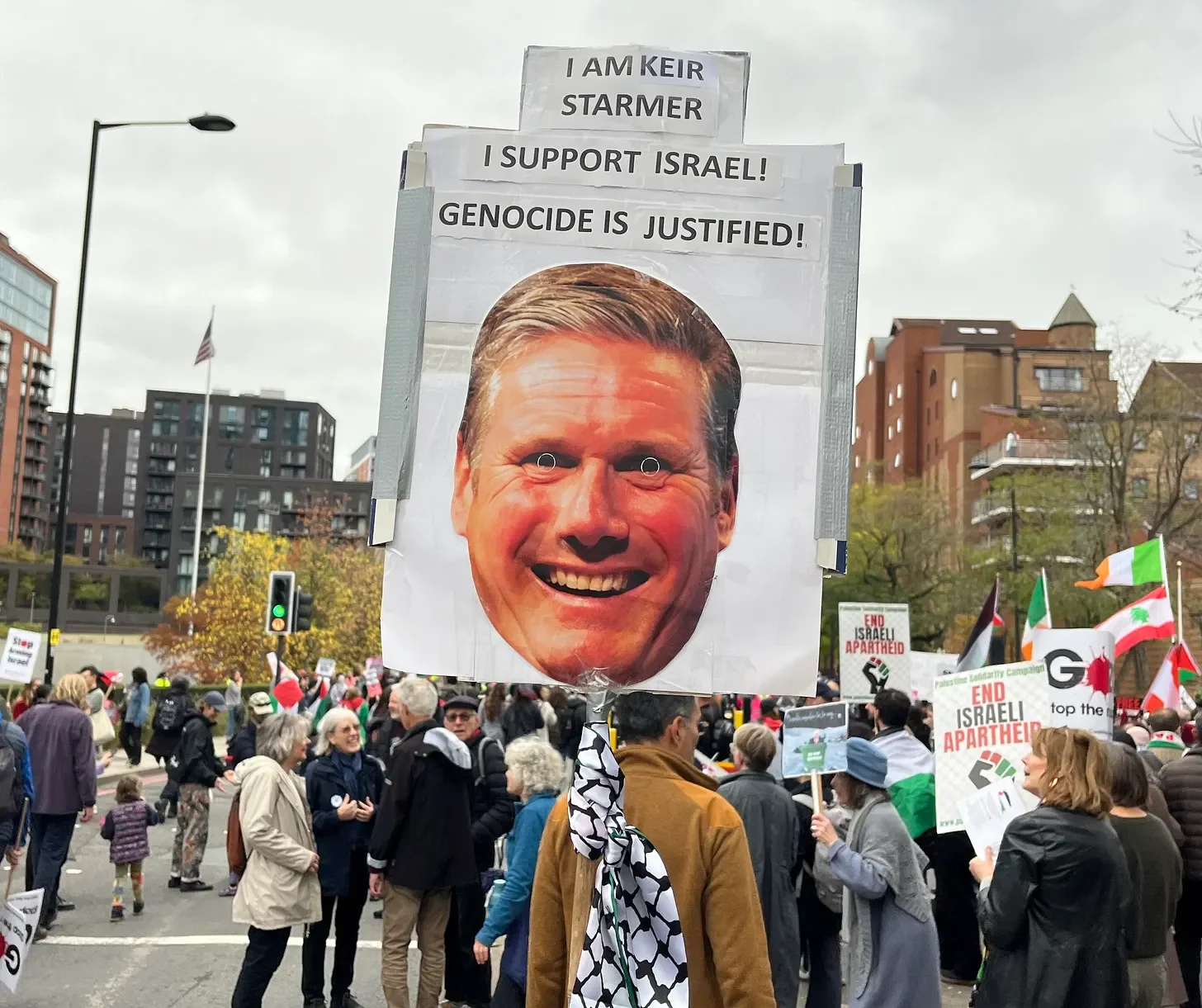
Solidarity rally, London, January 2025.
This conviction is only apparent because when the antisemitism storm was circling around Corbyn from 2015-19 Starmer had nothing to say about antisemitism. Appointed to the shadow Cabinet in 2016, he didn’t detect a problem with anti-Jew hatred—so didn’t approach Corbyn or any other senior Labour figure to say that the party needed to clean up its act. But soon after Corbyn lost the general election of 2019 Starmer made “rooting antisemitism out of the Labour party” his primary mission. He turned to Sir Trevor Chinn, a prominent Jewish-Zionist sympathiser, to fund his campaign to the tune of £700,000. Starmer’s campaign manager Gordon McSweeney forgot to declare that sum, breaking election rules. Hermer donated £5,000—perhaps as much as a week’s pay after tax. Once elected Starmer appointed McSweeney as his chief of staff, fully aware that McSweeney was prepared to ignore due process. His elimination of antisemitism in the Labour party revolved around him expelling a large number of Jews who happened to be critical of Israel.
Starmer painted himself as a suit who would bring order to the Labour party when all he was intent on was factional skulduggery that would serve the interests of his core Jewish-Zionist backers. Having promised to implement Corbyn’s basic programme via ten pledges he made during his campaign to become leader, Starmer rapidly dropped all of these commitments as he repeatedly pivoted to the anti-migrant right. Since becoming prime minister he’s only been able to speak with a degree of passion on Ukraine and, above all, antisemitism.
His apparently politicised lack of interest in tackling other forms of racism, including Islamophobia, became clear soon after he moved into Downing Street. During the summer of 2024, when far right, Islamophobic riots spread across the UK for two weeks, attacking and setting fire to numerous mosques and hotels that housed Muslim migrants, Starmer only managed two public statements. Neither of them mentioned that the victims were Muslim. He didn’t use the word Islamophobia. He only used the word “mosque” twice when he uttered “mosques are being attacked because they are mosques”. During numerous overtly Islamophobic attacks, several of them attempted murders, Starmer has said nothing. His government’s inquiry into anti-Muslim hatred ruled out use of the word Islamophobia in the interest of protecting free speech. But if an antisemitic attack is brought to Starmer’s attention he’s all over it like a fire in a storm. Antisemitism has been his “on” button.
Starmer is of course right to condemn antisemitism and to seek to protect Jewish people. (I hesitate to use the word “community” because UK Jews are almost completely split between those who openly criticise Israel’s war crimes and genocide and those who see their primary role as to defend Israel.) He was right to show concern for the victims of the attack on the Manchester synagogue last autumn. He was right to respond to the recent spate of attacks on Jewish property as well as the stabbing of two Jewish men in Golders Green on 29 April.
But Starmer has also come across as a manipulative, duplicitous and frankly racist leader in the way he has responded to the antisemitic attacks. When he expressed his determination to make the streets safe for Jewish people on 29 April he should have made the same commitment to Muslims given that the attacker’s first victim was a Muslim man and Muslims have experienced spiralling racism since he rose to power. When he responded to the four attacks on Jewish property—which began with the arson attack on Jewish ambulances on 23 March and ran through to the attack on Kenton synagogue on 23 April—he should have focused on reassuring the Jewish community about their concerns for safety while committing himself to discovering the cause of the attacks. Above all he should have avoided weaponising the attacks on Jewish property for ulterior political motives because that turns antisemitism into a political football.
Starmer has weaponised antisemitism relentlessly. He has portrayed Jews as the group that faces the greatest existential threat in the UK even though during 2025 attacks on Muslims rose by 20% and attacks on Jews fell by 25%. He has framed the attacks on Jewish property as terror-related when there’s no evidence to support this claim. He has used the attacks as a springboard to proscribe the IRGC, even though there’s no evidence of Iranian military involvement. He has cited rising Jewish fear as a reason to restrict the solidarity protests, even though the protests are proudly anti-racist and there is no evidence connecting the protests with the attacks. He’s harnessed the attacks on Jewish property to once again portray the people who are protesting against Israel’s genocide as the problem, while those who support Israel and refuse to critique its genocide are the solution. And he has also started to weaponise the attacks in order to attempt to discredit the Green party—the party that just so happens to have risen in popularity in inverse proportion to Starmer’s collapse in popularity.
Starmer’s weaponisation of antisemitism to disrupt the Greens dates back to the Gorton and Denton by-election, which took place on 26 February. During the campaign a senior cabinet minister told the Times that “The Greens are whipping up hatred and deliberately raising the salience of Gaza”—as if it’s antisemitic to note that the government has been supportive of Israel’s genocide. Green candidate Hannah Spencer—a 34-year-old plumber who focused her campaign on the cost of living crisis—won a massive victory, receiving 41% of the vote, up 27% on the 2024 election result, while the Labour candidate received 25% of the vote, down 25% from the 2024 result.
Labour would have had a much better chance of winning the by-election if Starmer had allowed Manchester Mayor Andy Burnham to run as Labour’s authentic as well as popular local candidate. But Starmer is a political control-freak who feared that Burnham might use a victory as an eventual springboard to become leader—and the one thing Starmer can’t tolerate other than Palestine solidarity campaigners are Labour politicians who have a degree of talent, charisma and purpose. So he ruled that Burnham shouldn’t be allowed to stand. When Labour’s vote collapsed Starmer blamed Greens for embracing “the politics of extremism”. He was referring to Spencer’s opposition to Israel’s genocide.
The Green victory in Gorton and Denton was shattering for Starmer. Up until that moment he’d been able to cling on to the idea that Labour represented the only party that could stave off the rise of Nigel Farage’s far right Reform party while holding the Conservatives at bay. In reality many people already couldn’t make a meaningful distinction between Starmer’s Labour and the far right. Aligned with those who refused to vote for Kamala Harris in the US election, or Andrew Cuomo in the NYC mayoral election, an extremely high proportion of left-of-centre voters already preferred to support the Greens rather than vote for a party that supported the corporate status quo and didn’t believe that genocide is an important issue. Spencer’s massive victory announced that the Greens had sailed past Labour as the party that could challenge the right—not just Reform and the Tories but also Labour.
Starmer’s attempt to portray the Greens as antisemitic began properly during an interview with the Jewish News following the attack on the Jewish synagogue in Kenton on 23 April. In an interview given to Haaretz the previous day, Zack Polanski said: “I’m concerned about rising antisemitic attacks. We saw arson attacks on ambulances for instance and we know that increasingly Jewish communities are feeling unsafe. There’s a conversation to be had about whether it’s a perception of unsafety or whether it’s actual unsafety, but neither are acceptable”. During a visit to Kenton synagogue, Starmer listened to the concerns of the chair, congregants and the chief rabbi, Ephraim Mirvis.
Mirvis asked Starmer to “guarantee the normalisation of antisemitism in the UK will stop, and that there will be zero tolerance.” He added that the IRGC must be proscribed along with all other terrorist organisations. United Synagogue president, Saul Taylor, commented: “The prime minister should declare publicly what the Jewish community has known for some time, this is an epidemic of anti-Jewish hate.” According to Jewish News, Taylor criticised Starmer’s delay in proscribing the IRGC and “called for steps to halt pro-Palestinian hate marches.” Whether or not they primed Starmer to attack the Polanski—a regular participant in the anti-genocide protests—is unclear. Maybe Starmer didn’t need priming.
Asked by Jewish News what he thought of Zack Polanski’s comments to Haaretz, Starmer replied: “I think it’s disgraceful, and to even suggest that this is a perception of the reality is to totally misunderstand antisemitism. This is very real. It’s visceral, and it’s felt throughout the whole community, and anybody denying or belittling that is guilty of all the usual assumptions in relation to antisemitism.”
Starmer added: “It’s really important. I have no doubt in my mind about just how real this is and the impact it’s having. You have families and individuals who are worried about whether they can wear their traditional clothing and jewellery in public when they have to hide their identity, which is very, very real. You have people who’ve been subjected to an attack in this very synagogue who are clearly feeling very fearful, and I think it’s disgraceful for anybody to suggest otherwise.”
In this instance Starmer—who is one of the least articulate politicians to ever walk the face of this earth—is unable to explain Zack’s simple point. He claims that Zack—a Jewish person who grew up in an pro-Zionist, observant family that changed its surname to hide its Jewishness—that he totally misunderstands antisemitism. Starmer proceeds to claim that antisemitism is “very real” before any antisemitic motive has been established in any of the recent attacks.
Starmer goes on to make shit up when he argues that the visceral reality of antisemitism is felt through the whole community—even though approximately 60% of diaspora Jews believe that Israel has perpetrated war crimes and 40% believe it has carried out a genocide. Something like 50% of Jews don’t identify with Israel and in all likelihood don’t go about afraid of antisemitism. This is made clear by the thousands of UK Jews who attend solidarity demonstrations. Maybe the mainstream Jewish-Zionist community wants to stop the demonstrations not because of their opposition to Israel but because so many Jews attend the rallies—and disrupt the idea that the Jewish-Zionist establishment is representative of UK Jewry. The phrase “I have no doubt in my mind about just how real this is and the impact it’s having” is no more than posturing.
As for the Jewish people who are concerned about wearing clothing or jewellery that might identify them as Jewish, it’s not at all clear how many Jewish people feel this way. If Jewish people are removing the markers of their Jewishness—a kippah/skull cap or star of David jewellery—for fear of antisemitic attack this is regrettable. I haven’t been able to find out how widespread this phenomenon might be.
I do know of someone who is so scared of antisemitism right now they have told their son not to wear their star of David. The family happens to live in one of the most comfortable and safe parts of London. I don’t believe they’ve ever experienced any antisemitism firsthand. Meanwhile my daughter had a tattoo of “Hai”—Hebrew for life—tattooed on her sternum. She did this because a dear aunt who passed had given her a necklace with a Hai pendant and she wanted to remember her that way. My daughter continues to walk about in a relaxed and happy way. She also attends solidarity events without fear. I love the way she walks through life, open-hearted, trusting, concerned about the welfare of people less fortunate than she is.
So far no motive has been established for the ambulance attack or the Kenton synagogue attack. The same is true for an attack on Finchley Reform synagogue (where I was once briefly a member) and a Jewish Futures educational building (that had not been in use for two years). Only minor damage was caused at the three buildings and nobody was injured in any of the attacks. All four have been claimed by Harakat Ashab al-Yamin al-Islamia, or HAYI. The group claims to be Iran-backed. It also appears to be fictitious.
The reasons for this are multiple. As Craig Murray points out, the group claims to be backed by Iran but only appeared mysteriously when Israel and the US began their attack on Iran. Its early activity revolved around acts of minor damage to Jewish community property in Belgium and the Netherlands. Right after the first small fire in Rotterdam, four Israeli groups simultaneously issued statements. The group’s manifesto uses language about Israel that no Islamic group would ever use, and also published in Arabic, not Farsi. It’s logo appears to be AI-generated and features incorrect Arabic lettering. Of some note, there were no injuries suffered following any of the group’s attacks.
Iran has no record of attacking health care facilities. There has only been one confirmed conviction related to an Iran-related terror attack on European soil, a 2018 Paris bomb plot, carried out by Assadollah Assadi, Third counsellor at the Iranian embassy in Vienna, Austria. It doesn’t amount to much in the 47-year history of the Islamic Republic, established in response to West’s colonial, oil-driven overthrow of Iran’s democracy in 1953, which paved the way for 25 years of autocratic rule by Shah—until the Iranian Revolution of 1979 reasserted Iranian control.
It’s possible that the attackers were motivated by antisemitism. Maybe it’s even probable. Yet the pattern of the sequence of property attacks indicates that a bunch of kids and very young adults were hired to do a job. The charges authorised so far relate to the intention to damage property via arson. None of the charges refer to the attacks being racially motivated. Right now the perpetrators don’t look like antisemites. And there’s no reason to believe that HAYI exists. Everything about it is fake. There’s no credible link to Iran. So who might be coordinating these apparently linked attacks? Could it even be Zionists—either from within Israel or as part of Israel’s extended network of control—control that has, according to even the timid, pro-Zionist New York Times, seized control of the White House? Could such a grouping coordinate a few small scale false flag arson attacks in Europe to serve Israel’s strategic interests?
Certainly we’re long overdue a proper debate about antisemitism that is considered and takes a broad range of views into account. An extensive analysis has evolved that explains how Jews who’ve taken a stand against genocide are routinely accused of being antisemitic. Yet to accuse a Jew who takes such a stand of being an antisemite is itself clearly antisemitic because it attempts to attribute to a particular group of Jews—Jewish Zionists—the right to define who is a Jew and how that Jew should conduct themselves. Were a non-Jew to start to do this to Jews they would rightly be called an antisemite. If a Jew does this to other Jews, just because they don’t support their point of view, they’re also guilty of antisemitism.
The other days, beneath a short piece I posted about the arson attack on Jewish ambulances on 23 March, an extremely aggressive and presumptuous person who identified as a Jew repeatedly told me that I’m a self-hating Jew, that I’m repeating the antisemitic playbook, etc. Along the way she talked about the fear she and people she knew were feeling, and how I was denying their right to be victims. I did reply along the line of: yes, if a grouping is unable to criticise Israel during a genocide/invasion/illegal war in which it has murdered tens of thousands of innocent civilians, many of them babies and children, you do lose your right to claim victimhood. Whether or not that was a fair point, she became so hostile she told me that she doesn’t even believe that I’m Jewish and accused me of making up that my dad came out of Nazi Germany. Because I didn’t fit her idea of what a Jew should do and think I couldn’t be a Jew. To me this is antisemitism.
To me it’s obvious that antisemitism is a complex phenomenon that needs to be discussed and recalibrated. This discussion has to account for the vast number of Jews who don’t identify with Israel yet clearly aren’t antisemitic. Zack entered the fray in a reasonable and thoughtful way. He was clear that it’s as important to eradicate the fear of antisemitism as whatever form antisemitism might take.
However the establishment Jewish-Zionist community along with Starmer are absolutely opposed to any mature discussion taking place. That’s because any such conversation would detract from their ability to control the narrative for their political ends—the reinforcement of their power. In Starmer’s case a conversation about antisemitism might also undermine the entire basis for his rise to the pinnacle of UK politics. Nor does he want to explore whether Israel’s expansionist, genocidal, warmongering conduct—all carried out under the flag of the “Jewish state”—might be the number one cause for contemporary manifestations of antisemitism.
This is my perception. Israel is behaving in a way that plainly many people find hateful, genocide being the gravest crime known to humanity. Many people find support for Israel, or the excusing of Israel’s behaviour, during this period very hard to stomach. They also find the active celebration of Israel’s collective punishment, which floods through social media, repulsive. Because Israel repeatedly identifies itself as a Jewish state, and because establishment Zionists have falsely conflated anti-Zionism and antisemitism, the step between feeling hatred for Israel and Jewishness is becoming precarious. The answer is to distinguish between Jewishness and support for Israel during a genocide, or for Zionists to be ready to be critical of Israel for the sake of Israel’s survival as a state that can behave in a way that’s acceptable. Zack is ready to have this conversation, Starmer isn’t.
Instead Starmer and the wider Zionist establishment are portraying the recent series of non-fatal antisemitic attacks as a national emergency. On the day of the three stabbings Starmer called a COBRA meeting. A counter-terrorism official described antisemitism as the most severe national emergency since the two-year covid lockdown. Starmer is promising to clampdown on the perfectly legitimate solidarity protest movement. He wants to make the use of the phrase “globalise the intifada” a criminal offence.
Starmer does this not because those who reproduce that slogan want to instigate any violence. As with the chant “from the river to the sea, Palestine will be free,” “globalise the intifada” is a call for resistance and freedom. To be honest, I’ve barely seen or heard anyone use the “globalise” phrase on the demonstrations. But it doesn’t matter. These aren’t specific calls to action, they are declarations of hope. Starmer has refused to use the word “Islamophobia” in order to protect free speech but when it comes to the free speech of those who oppose colonial oppression the rights disappear. We’re not even allowed to say that we support Palestine Action. Palestine Action, explicitly a civil disobedience and not a terror organisation, isn’t even allowed to exist. This extremely repressive approach will never succeed. It will only create resentment that the establishment wants to impose its views through brute force. This is one of the key reasons why Starmer is so widely… hated. He is an autocrat who pretends to be a democrat.
Unfortunately Starmer’s frankly brainless posturing plays into the fears of the establishment Jewish-Zionist community. These fears are spiralling in a way that is fast losing any sense of proportion.
On 20 April the BBC aired a Panorama documentary titled “Antisemitism: Why British Jews Are Afraid” that devoted the entirety of the show to amplifying Jewish fears and warning of the mythological hatred on the solidarity protests. The main theme of the documentary was that UK Jews are thinking about leaving—and deliberately misrepresented trends in Jewish attitudes on this matter. It included a clip of Oswald Mosley, the leader of the British Union of Fascists, delivering an antisemitic speech at the Royal Albert Hall in 1935.
Interviewed on LBC on 28 April, the Jewish comedian Maureen Lipman compared the current climate in London to the pogroms in Nazi Germany at the dawn of Hitler’s rule. On 29 April Sue Siegel, a member of the Jewish Council of Scotland, said that feelings are “Similar to what people felt just before the Holocaust”.
Anticipating the series of comparisons with Nazi Germany, on 26 March the Wall Street journal ran an extended thought piece titled “Jews Begin to Wonder: Is Anywhere Safe?” with the subtitle reading “‘It feels like the 1930s again.’”
My dad grew up a Jew in Nazi Germany and lived through Kristallnacht in November 1938. At least 91 Jews were killed that night. Before the outbreak of the Second World War Hitler introduced eleven separate pieces of legislation that discriminated against German Jews. To draw this kind of parallel is hyperbolic and quite clearly disrespectful to the memories of those who survived Nazi rule and the Nazi genocide.
It’s important to make it clear that criticism of Israel doesn’t constitute a hatred for Jewish people. It’s also important to make it clear that it’s possible to radically disagree with someone’s view of Israel while not attributing that view solely to their Jewishness. Jews lived in the diaspora for two thousand years without wishing to return to Palestine. Jewishness is also pluralistic, not essentialist, with a deep affiliation to Israel one option on offer. Many non-Jewish Zionists—among them Christian Zionists—also support Israel’s actions in Gaza and beyond. So it needs to be made clear to the Jewish-Zionist community that there is nothing innate to being Jewish that is problematic here.
But the establishment isn’t interested in these distinctions. It understands that it is losing the argument, it’s losing voters, it’s losing viewers and listeners, but is run by people who are too inflexible and to embroiled in the existing power structure to change course.
The Times responded to Starmer’s pumped-up attack by publishing an antisemitic caricature of Zack on Saturday 2 May that gave him a classically racist “large, hooked, Jewish nose”—a favourite depiction during the Nazi era (see the pic). Thankfully a number of representatives of the establishment Jewish community condemned the cartoon for its reproduction of classic antisemitism. This is encouraging. However the Times refused to apologise for the caricature. Starmer’s office was asked to comment on the cartoon. Disgracefully he has not responded. He is so quick to condemn antisemitism when it’s to his political advantage—otherwise he is silent. Hermer, who has made numerous statement deploying the rise in antisemitism, has also been silent.
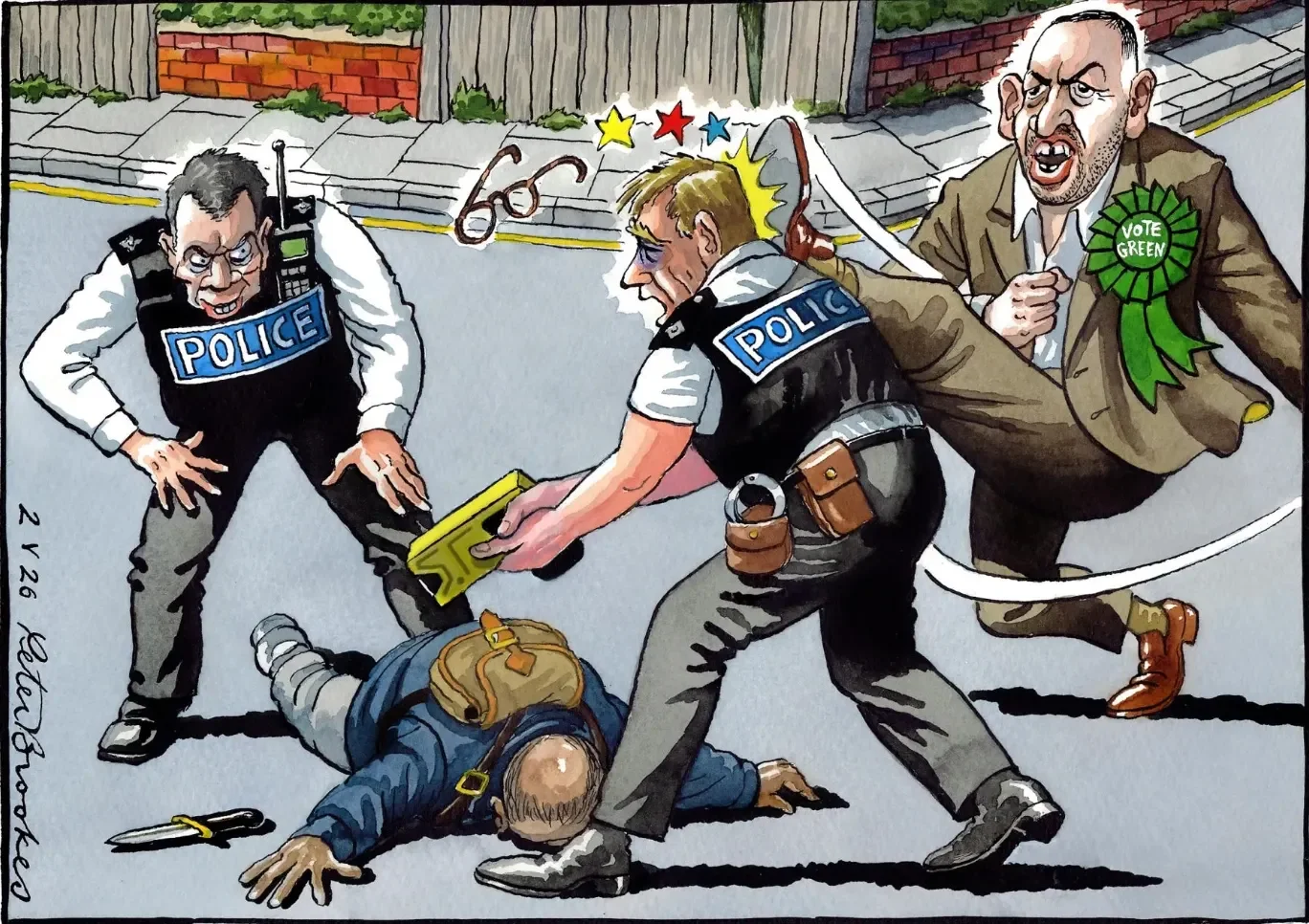
Antisemitic caricature of Zack Polanski in the Times
Instead on 4 May Labour’s communities secretary Steve Reed released a formal “dossier” naming 25 Green party candidates who hold “hateful and dangerous views”. Looking through the allegations, some of the comments attributed to the candidates are reasonable in the context of the genocide and the conflation of anti-zionism and antisemitism. No action should be taken. Others examples are more obviously antisemitic. Should everyone associated with the latter group be removed from the UK political arena. No, there is a precedent for people who engage unknowingly or ignorantly in such behaviour to apologise and engage in some education. Naturally this education shouldn’t erase the right to be highly critical of Israel’s genocidal behaviour.
Starmer should be admitted to these classes on antisemitism, just as he undertook unconscious bias training in 2020—this after he described Black Lives Matter protests as a “moment” and dismissed the idea of defunding the police as “nonsense”. It would be hypocritical for the Labour party to expect the Greens to dismiss instances of bias in their party if Starmer was allowed to continue after expressing his own bias.
The BBC has inevitably joined in the attempt to discredit Zack. I had the misfortune of seeing a recording of Laura Kuenssberg’s interview with Zack on her flagship political programme “Sunday with Laura Kuenssberg” on 3 May. The entire interview amounted to a hatchet job. Kuenssberg—the political editor of the BBC from 2015-22—challenged Zack on antisemitism in the Green party as well the party’s drug policy (which follows public health recommendations).
Paid £400,000 to educate the BBC audience about politics, she didn’t ask Zack a single question about Green party’s economic policy, its environmental strategy or broader social policy. She didn’t ask him anything about foreign policy or the party’s approach to Israel. She constantly interrupted him while he was attempting to provide an answer. She chided, demeaned and patronised him. She is one of many reasons why I stopped paying the licence fee—and because of that cannot watch any TV at all—over two years ago. She and many of her colleagues at the BBC and in the mainstream media are an absolutely disgrace to their profession.
Zack handled Kuenssberg’s hostile questions admirably. He remained calm. Whenever he could grab a couple of seconds he did his best to add context or introduce the kind of comment he would have been able to make freely were he not facing an interviewer set on destroying him. He made it clear that he is opposed to antisemitism and would act against antisemitism. Some might feel that he reacted too severely to the barrage of accusations directed at him and the Green party these last few months. I don’t know. It’s always easy to demand greater purity. The tough lesson of the Corbyn years is to be clear about condemning antisemitism while standing firm in one’s basic critique of Israel and keeping the dialogue open in a non-defensive way.
I think Zack is doing very well. Once again we have a party that is committed to serious economic reform as well as a new, anti-colonial, anti-warmongering approach to foreign policy. He’s exactly what we need right now—someone who can embrace the best that Corbyn had to offer while delivering progressive ideas in a more agile, telegenic way—or the UK’s Zohran Mamdani.